Two of the most common questions in Pokemon Pokopia are deceptively simple: do crystals respawn, and do glowing mushrooms respawn? The answer to both is yes — but the respawn system has more nuance than you might expect. Different resource types have different timers, some nodes give rare drops on a random cycle, and certain techniques let you manipulate the clock to farm materials faster.
Esta guía covers every resource type in Pokopia, their respawn mechanics, exact timers, the best farming routes through each region, and the tricks that experienced players use to keep their storage boxes overflowing with materials. Whether you need crystals for late-game crafting or glowing mushrooms for furniture and recipes, the information here will make your farming runs as efficient as possible.
Cómo Resource Respawning Works in Pokopia
All harvestable resources in Pokopia operate on the same basic system: you gather them, they disappear, and they come back after a set number of in-game days. The timer ticks forward based on the in-game clock, not real-world time. This is an important distinction because it means sleeping in a bed, which advances the clock to the next morning, is the fastest way to trigger respawns.
Each resource node has a fixed location. Crystals grow in the same cave wall spots. Mushrooms pop up on the same logs and cave floors. Ore veins reappear in the same rock faces. Once you learn where your resources spawn, you can run the same route every few in-game days and collect a predictable haul.
The respawn check happens at the start of each new in-game day (when the sun rises or when you wake up from sleep). If a resource has met its timer requirement, it appears at dawn. If not, it stays gone until the timer is fulfilled.
One more thing — resources that have been gathered by follower Pokemon (like a Geodude mining ore as you walk past) follow the same respawn rules. There is no difference between manually gathering a node and having a follower do it.
Complete Respawn Timer Table
Aquí está cada resource type and how long it takes to respawn after harvesting.
| Resource Type | Respawn Timer | Where Found |
|---|---|---|
| Wood (common trees) | 2 in-game days | All regions |
| Hardwood (dark oak) | 3 in-game days | Verdant Meadow, Amber Ridge |
| Bamboo | 1 in-game day | Verdant Meadow groves |
| Stone deposits | 2 in-game days | All regions |
| Iron ore | 3 in-game days | Caves in all regions |
| Gold ore | 4 in-game days | Deep caves, Amber Ridge |
| Crystal deposits | 3 in-game days | Frozen Peak, Crystal Shores caves |
| Glowing mushrooms | 2 in-game days | Caves, shaded forests |
| Regular mushrooms | 1 in-game day | Forest floors, near trees |
| Flowers (all types) | 1 in-game day | Fields, meadows |
| Clay | 2 in-game days | Riverbeds, lakeshores |
| Sand | 2 in-game days | Beaches, desert areas |
| Volcanic stone | 4 in-game days | Frozen Peak lava areas |
| Luminous moss | 3 in-game days | Frozen Peak cave walls |
| Ancient bricks | 5 in-game days | Scorched Desert ruins |
| Coral | 3 in-game days | Crystal Shores underwater |
| Berries (bushes) | 1 in-game day | All regions |
| Fruit (fruit trees) | 3 in-game days | Verdant Meadow, planted trees |
| Seeds | 1 in-game day | Tall grass, flowers |
| Honey flowers | 2 in-game days | Fields, gardens |
Each in-game day lasts approximately 12 real-world minutes on the default time setting. So a 3-day respawn timer translates to roughly 36 minutes of real play if you do not sleep through nights.
Crystal Deposits — Respawn Mechanics and Best Farming Spots
Crystals are one of the most sought-after resources in the game. You need them for Crystal Blocks (transparent building material), Crystal Roofing, several late-game crafting recipes, and furniture that glows. The demand never stops, but crystal deposits are limited per area and take 3 in-game days to come back.
Dónde Crystals Spawn
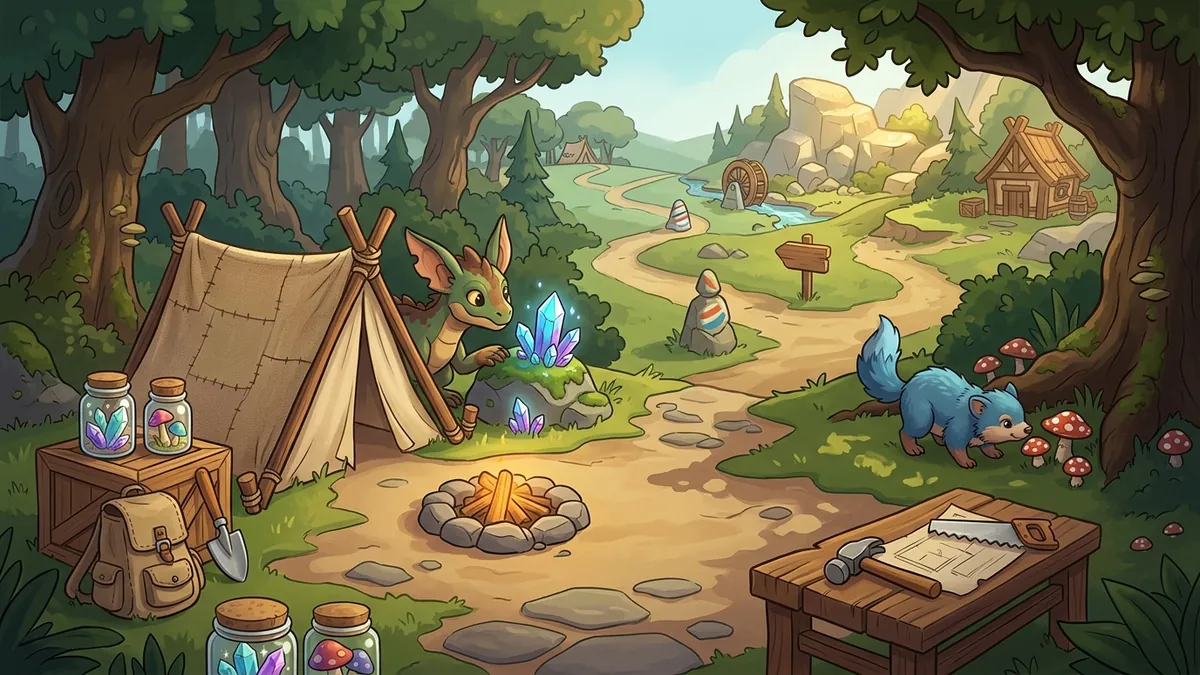
Crystal deposits appear exclusively in cave systems. They look like jagged, blue-white clusters growing from cave walls and ceilings. You need a pickaxe (or a Pokemon with the Mine Specialty) to harvest them.
Frozen Peak Upper Caves — The highest crystal density in the game. A single run through the upper cave loop passes 18-22 crystal nodes. This is the best farming location once you have access to Frozen Peak. Bring a Torchic follower for light since these caves are pitch dark.
Crystal Shores Caverns — The second-best location with 14-16 nodes per loop. The caves here are better lit than Frozen Peak and closer to the region’s Pokemon Center, making runs more convenient.
Amber Ridge Caverns — A good early-game option with 12-15 nodes. The caves are accessible before you unlock the later regions and the crystal quality is the same.
Verdant Meadow Hidden Cave — Only 5-7 nodes, but this cave is available from very early in the game. If you need crystals before Amber Ridge opens up, this is your spot.
Crystal Farming Route (Frozen Peak)
The most efficient crystal farming run follows this loop:
- Start at Frozen Peak Pokemon Center
- Head north into Upper Cave entrance
- Follow the left wall through the first chamber (6-8 nodes)
- Take the tunnel to the second chamber (5-6 nodes)
- Exit through the eastern passage into the ice canyon
- Re-enter through the Lower Cave South (4-5 nodes)
- Follow the path back to the Pokemon Center exit
This loop takes about 8-10 minutes and yields 18-22 crystal deposits. Sleep through the night, do it again in 3 in-game days. Pair it with a mining follower team — Geodude and Drilbur handle most of the work while you walk the route. For follower team setups, nuestra followers guide covers the ideal mining party.
Glowing Mushrooms — Respawn Mechanics and Locations
Glowing mushrooms are the other resource that sends players searching for answers. These bioluminescent fungi appear in caves and heavily shaded forest areas, emitting a soft teal glow. They are used in cooking (Glowing Mushroom Soup is one of the best PP-restoring meals), furniture crafting (Mushroom Lamps), and several Important Requests.
Respawn Details
Glowing mushrooms respawn every 2 in-game days, making them one of the faster-respawning resources. They grow back in exactly the same spots — on cave floors, fallen logs, and damp stone surfaces. Unlike crystal deposits, you do not need a tool to gather them. Walk up and press A.
Mejores Glowing Mushroom Locations
Verdant Meadow Undergrove — A shaded forest area near the waterfall. Contains 10-12 glowing mushroom spawns on rotting logs and near the stream. This is accessible from day one and the best early source.
Frozen Peak Ice Caves — The lower sections of Frozen Peak caves have 8-10 glowing mushroom spawns along damp walls. You will pass these naturally while farming crystals, so combine both runs.
Amber Ridge Mushroom Cavern — A dedicated cave section with 15-18 glowing mushroom spawns. This is the single densest location for mushrooms in the game. The entrance is near the southern bridge in Amber Ridge.
Crystal Shores Tide Caves — Mushrooms grow in the tidal cave sections. Around 6-8 spawns, but these caves also contain coral, making the trip worthwhile for multiple resources.
Mushroom Farming Tips
- Glowing mushrooms can be planted on crafted Mushroom Logs in your base. Planted mushrooms grow on a 1-day cycle, giving you a renewable source without running routes.
- The Grow Specialty (Bulbasaur line) accelerates planted mushroom growth just like crops.
- Cooking with glowing mushrooms produces higher-PP meals than regular mushrooms. Prioritize them for your kitchen.
Ore and Metal Resources
Ore deposits follow the same respawn logic but have longer timers for rarer metals.
Iron Ore (3-day respawn)
Iron is the workhorse metal. You need it for Iron Beams, tools, and most mid-game crafting. Every cave in every region has iron deposits, usually 8-12 per cave system. The Geodude Mine Specialty handles iron automatically if it is following you.
Gold Ore (4-day respawn)
Gold ore appears in deep caves starting from Amber Ridge onward. There are far fewer gold nodes than iron (3-5 per cave). Gold is used for decorative furniture, Gold Bricks, and several Important Request items. Because of the 4-day timer and limited nodes, gold is always in short supply. Nuestra crafting recipes guide lists every gold recipe so you can prioritize.
Volcanic Stone (4-day respawn)
Exclusive to Frozen Peak’s lava areas. Only 4-6 nodes exist, and they take 4 days to return. Volcanic Stone is used for forges, fire-resistant construction, and a handful of rare furniture items. Farm it every time you visit Frozen Peak — do not skip nodes.
Wood and Plant Resources
Wood and plant resources respawn faster than minerals, making them more forgiving to farm.
Tree Regrowth
Common trees (Oak, Birch, Pine) regrow 2 in-game days after being fully chopped. The stump remains and the tree grows back to full size. You never permanently lose trees — even if you clear-cut an entire forest, it comes back.
Hardwood trees (Dark Oak in Verdant Meadow) take 3 days. Bamboo is the fastest at 1 day, making it the most renewable building material in the game. If you need large quantities of a specific wood type, consider planting a tree farm with saplings from nuestra seeds and plants guide.
Flower and Berry Respawns
Flowers and berry bushes respawn daily. Wild flowers are your source for crafting honey, so their fast respawn rate ensures you never run dry. Berry bushes give 2-3 berries per harvest and grow back every morning.
Fruit trees are different — the tree stays, but the fruit takes 3 days to regrow after picking. If you rely on specific fruits for cooking, plant extra trees near your kitchen to maintain supply.
Cómo Speed Up Respawn Cycles
Since respawn timers are tied to in-game days, advancing the clock is the key to faster farming. Here are the methods.
Sleep through the night. The most straightforward approach. Build a bed near your farming route’s starting point and sleep at the end of each run. Each sleep advances the clock to the next morning, ticking one day off every respawn timer.
Time skip via cooking. Certain long-cook recipes (like Slow-Roasted Stew) advance the clock by several hours. Cooking multiple long recipes back-to-back can push the day forward faster than waiting.
Multiplayer day cycling. In multiplayer, the host controls the clock. If the host sleeps, the day advances for everyone. Coordinate with friends to cycle days quickly while each player runs different farming routes.
Avoid idling. Standing still does not advance the in-game clock faster. The clock runs at a fixed pace, so always be doing something productive while waiting for respawns — crafting, building, organizing storage.
Resource Farming Best Practices
A few principles that make resource farming in Pokopia consistently productive:
- Run fixed routes. Memorize the locations of high-value nodes and run the same path every time. Consistency beats wandering.
- Combine resource types per run. A cave that has crystals, iron, and glowing mushrooms gives you three materials in one trip. Plan routes that overlap.
- Use follower teams. A mining follower team (Geodude, Drilbur, Dugtrio) collects most resources passively as you walk. You only need to manually interact with nodes they miss.
- Bring food. Mining and chopping drain PP fast. Carry cooked meals — nuestra recipes guide covers the best PP-restoration meals for long farming sessions.
- Store materials near crafting benches. Place storage boxes next to your crafting bench so materials flow directly into crafting without manual transfer. The storage guide covers the optimal layout.
- Track rare drops. Ancient Shards, Luminous Moss, and other rare materials drop randomly from their nodes. Keep a mental note of which nodes you have farmed and when — the more you harvest, the better your odds on the next cycle.
Rare and Unique Resources
Some resources do not follow standard respawn rules or have special conditions.
Ancient Shards — These drop from Ancient Brick nodes in Scorched Desert ruins at a roughly 15-20% rate. The node itself respawns every 5 days, but the shard drop is random. You might get one every run or go three runs without one.
Stardust — Found only on Cloud Islands at night. It spawns on the ground as sparkles between 10 PM and 4 AM in-game time. Does not have a fixed respawn timer — it appears fresh every night.
Fossilized Amber — Exclusive to Amber Ridge cave walls. Similar to Ancient Shards, it is a rare drop (10-15% chance) from specific amber-colored rock nodes that respawn every 4 days.
Rainbow Coral — A rare variant of normal coral in Crystal Shores. Spawns in the deepest tidal caves and respawns every 5 days. Used in the most decorative furniture items.
FAQ
Do crystals respawn in Pokemon Pokopia? Yes. Crystal deposits respawn every 3 in-game days (about 36 real-world minutes). They reappear in the same locations, so you can farm the same cave routes repeatedly.
Do glowing mushrooms respawn in Pokopia? Yes. Glowing mushrooms respawn every 2 in-game days (about 24 real-world minutes). They grow back in their original spots across caves and shaded forest areas.
What is the fastest way to farm resources in Pokopia? Build a mining team of followers (Geodude, Drilbur, Dugtrio), run a fixed farming route through crystal caves and mushroom spots, and sleep through nights to advance the in-game clock.
Do trees regrow after being chopped in Pokopia? Yes. Chopped trees regrow after 2 in-game days. Fruit trees take 3 in-game days to regrow fruit after harvest, but the tree itself is never destroyed.
How do respawn timers work in Pokopia? Respawn timers are tied to in-game days, not real-world time. Sleeping in a bed or advancing the clock through activities progresses the timer. Resources respawn at the start of each new in-game day.
Can I increase resource spawn rates in Pokopia? Not directly, but certain Pokemon Specialties and food buffs increase the amount of material you get per node. The Stonework Specialty increases stone drops, and Mining Meals boost ore yields.
Where are the best crystal farming spots in Pokopia? Frozen Peak Upper Caves has the highest crystal density with 18-22 nodes per run. Amber Ridge Caverns is second with 12-15 nodes and easier access early in the game.
Do rare resources like Ancient Shards respawn? Ancient Shards and other rare drops have a low respawn chance. Nodes respawn on schedule, but the drop is random — expect the rare material roughly once every 5-8 harvests of that node.