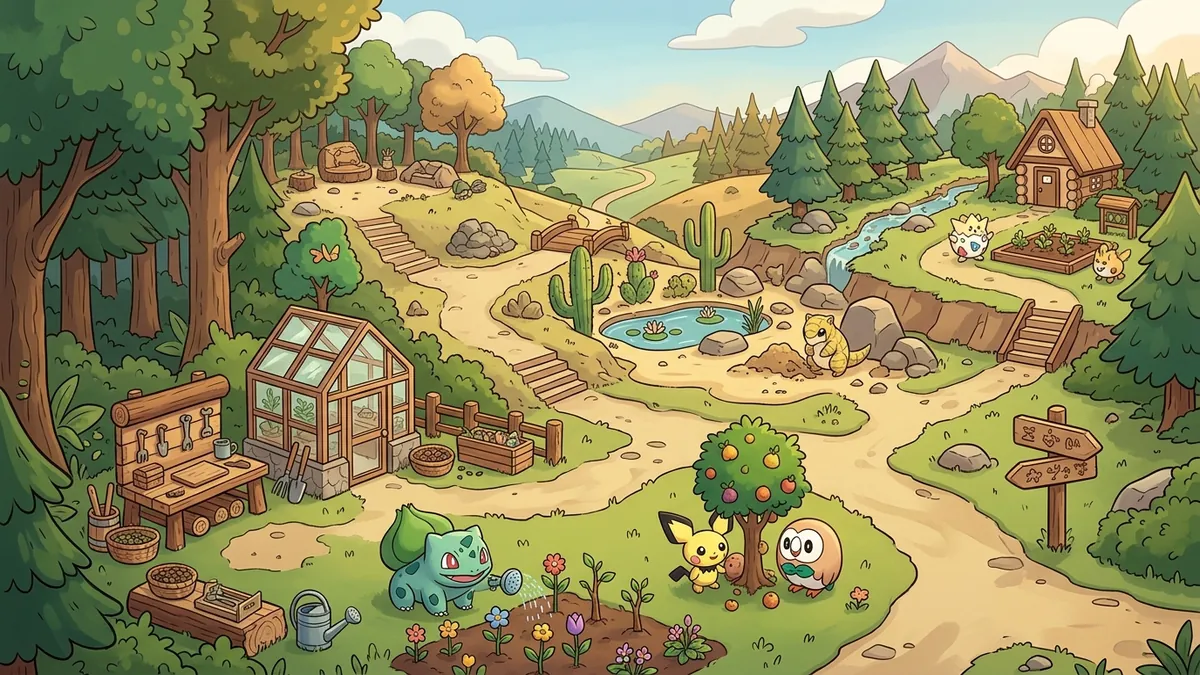
Specialties are the backbone of everything you do in Pokemon Pokopia. Every befriended Pokemon comes with one of nine standard specialties — a persistent ability that lets it contribute to farming, building, crafting, resource gathering, or utility tasks on your island. You do not need to command your Pokemon to use their specialty. Once assigned to a task or placed near the right workstation, they do it automatically.
Understanding which specialties exist, which Pokemon carry them, and how to build a team that covers all nine is the difference between a smooth mid-game and a frustrating bottleneck. This guide breaks down every specialty in detail, recommends the best Pokemon for each, and explains how specialties interact with the building, farming, and crafting systems. If you are brand new to Pokopia, start with our beginner guide to learn the basics before diving into team optimization.
How Specialties Work
When you befriend a Pokemon, it comes with a fixed specialty that you can see on its profile screen. This specialty determines what kind of task the Pokemon can automate or assist with.
You do not micromanage specialties. Instead, you place the Pokemon near the relevant station or area, and it begins working on its own. A Cut-specialty Pokemon placed near a forest will chop trees. A Water-specialty Pokemon placed near crops will irrigate them. A Generate-specialty Pokemon placed near a lamp post will power it.
There are a few universal rules across all specialties.
Comfort Level matters. A Pokemon’s specialty efficiency scales directly with its Comfort Level. At Comfort 100, a Pokemon works roughly 60% faster than one at base Comfort. This makes raising Comfort through mini-games and feeding a priority for your most important workers. See our mini-games guide for the fastest Comfort strategies.
One specialty per Pokemon. No Pokemon carries more than one specialty. This is why team composition is critical — you need coverage across multiple specialties to keep your island running.
Specialty cannot be changed. With one exception (evolution-based changes), a Pokemon’s specialty is permanent. Choose your team members carefully.
Active party vs island workers. Pokemon in your active party (up to 6) use their specialties while following you. Pokemon placed on your island as workers use their specialties passively at their assigned station, even when you are away.
Burn — Fire Handling and Smelting
Burn-specialty Pokemon interact with fire-related tasks. They fuel furnaces, light campfires, clear overgrown brush, and operate the Smelting Station faster than you can by hand.
Key uses:
- Furnace speed boost. Place a Burn Pokemon next to your furnace and smelting times drop by 40-60% depending on Comfort.
- Brush clearing. Thorny bushes and dead hedges block paths in every region. Burn Pokemon clear them instantly when you walk near blocked paths with one in your party.
- Campfire maintenance. Campfires produce a warmth radius that prevents PP drain from cold weather in Frozen Peak and Sparkling Skylands. Burn Pokemon keep campfires lit indefinitely without needing fuel.
- Cooking acceleration. Burn Pokemon placed near a cooking station reduce cook times by 25%.
Best Burn Pokemon:
| Pokemon | Availability | Notes |
|---|---|---|
| Charmander | Starter pick | Strong all-around, early access |
| Torchic | Starter pick | Also lights dark areas (Flame move) |
| Vulpix | Withered Wasteland | Mid-tier efficiency, easy to befriend |
| Growlithe | Rocky Ridges | High Comfort ceiling, loyal worker |
| Litwick | Rocky Ridges caves | Best furnace efficiency in the game |
| Flareon | Eevee evolution | Premium option, requires Fire Stone |
Recommendation: Litwick is the standout choice for a dedicated furnace worker. Its Burn efficiency is the highest in the game, and its small size means it fits neatly beside any crafting station. For field use (brush clearing while exploring), Growlithe is better because it moves faster and has higher base PP.
Gather — Resource Collection
Gather-specialty Pokemon automatically collect loose resources in their radius. They pick up dropped items, harvest ripe wild berries, collect fallen wood, and vacuum up scattered materials after you break rocks or chop trees.
Key uses:
- Auto-pickup radius. Gather Pokemon have a 5-block collection radius that continuously pulls loose items into your inventory or the nearest storage box.
- Berry harvesting. Wild berry bushes throughout every region regenerate daily. A Gather Pokemon collects them automatically as you walk past.
- Post-action cleanup. After chopping a tree or mining a deposit, materials scatter on the ground. Gather Pokemon sweep them up instantly, saving the time you would spend manually pressing Y to inhale.
- Event item collection. During seasonal events, special collectibles spawn across the map. Gather Pokemon pick these up automatically.
Best Gather Pokemon:
| Pokemon | Availability | Notes |
|---|---|---|
| Zigzagoon | Withered Wasteland | Available early, decent range |
| Pachirisu | Rocky Ridges | Fast collector, pairs well with Cut Pokemon |
| Aipom | Bleak Beach | Largest collection radius in the game |
| Bunnelby | Withered Wasteland | Also digs up buried items occasionally |
| Dedenne | Sparkling Skylands | Small but efficient, good for tight spaces |
Recommendation: Aipom is the best Gather Pokemon in the game. Its collection radius extends to 8 blocks (compared to the standard 5), and it prioritizes rare materials over common ones. The tradeoff is that you cannot get Aipom until Bleak Beach, so Zigzagoon carries you through the early game.
Grow — Crop Acceleration
Grow-specialty Pokemon speed up the growth cycle of planted crops. Place one near your farm plots and watch your harvest times shrink dramatically.
Key uses:
- Crop speed boost. Grow Pokemon reduce crop growth times by 30-50% depending on Comfort. A crop that normally takes 3 in-game days to mature can finish in under 2 days.
- Seed quality improvement. Crops harvested while a Grow Pokemon is nearby have a higher chance of producing star-quality produce, which sells for more and cooks into better dishes.
- Soil enrichment. Grow Pokemon passively improve soil quality over time. After 5 in-game days of continuous presence, the soil in their radius permanently upgrades one tier.
- Weed prevention. Weeds do not spawn in farm plots within a Grow Pokemon’s radius.
Best Grow Pokemon:
| Pokemon | Availability | Notes |
|---|---|---|
| Bulbasaur | Starter pick | The gold standard for farming |
| Oddish | Withered Wasteland | Solid early option if you did not pick Bulbasaur |
| Roselia | Rocky Ridges | Strong efficiency, produces Berry Seeds as drops |
| Tropius | Bleak Beach | Covers the largest farm radius (10 blocks) |
| Snivy | Sparkling Skylands | Premium Grow efficiency, late-game unlock |
Recommendation: Bulbasaur is the best starter in the game largely because of how powerful early access to Grow is. If you picked a different starter, Oddish is available within your first few hours in Withered Wasteland and serves as an excellent substitute. For endgame farms, Tropius covers the most ground. Our farming guide pairs well with this section.
Water — Irrigation and Aquatic Tasks
Water-specialty Pokemon handle all water-related tasks. They irrigate crops, fill ponds, power water wheels, and enable aquatic resource collection.
Key uses:
- Crop irrigation. Water Pokemon auto-water all farm plots within their radius, removing the need to craft and use watering cans. This stacks with Grow — a farm with both a Water and Grow Pokemon nearby is the most efficient setup in the game.
- Pond and fountain filling. Decorative water features require water supply. Water Pokemon fill them automatically and keep them topped off.
- Water wheel power. Certain machines (grain mills, irrigation pumps) run on water wheels. Water Pokemon placed nearby power these indefinitely.
- Fishing assistance. A Water Pokemon in your active party increases rare fish catch rates by 20%.
Best Water Pokemon:
| Pokemon | Availability | Notes |
|---|---|---|
| Squirtle | Starter pick | Reliable all-around, early access |
| Piplup | Starter pick | Also grants Surf for early water crossing |
| Psyduck | Withered Wasteland | Common, easy to befriend, decent efficiency |
| Marill | Rocky Ridges | High irrigation radius |
| Vaporeon | Eevee evolution | Highest Water efficiency, requires Water Stone |
| Lapras | Bleak Beach | Premium option, also acts as a water mount |
Recommendation: Squirtle or Piplup from the starter selection gives you Water coverage from minute one. If you chose a different starter, Psyduck fills the gap quickly. Vaporeon is the best endgame Water Pokemon, and Lapras doubles as a transport mount for ocean exploration.
Generate — Power and Electricity
Generate-specialty Pokemon produce electrical power. They light lamps, charge batteries, power machines, and activate electrical circuits in your builds.
Key uses:
- Lamp lighting. Craft lamp posts and place a Generate Pokemon nearby. It powers every lamp within its radius, keeping your island lit at night without fuel costs.
- Machine power. Advanced crafting stations (Auto-Crafter, Assembly Line, Conveyor Belt) require power. Generate Pokemon are the primary power source.
- Battery charging. Portable Batteries can be charged by Generate Pokemon and then placed anywhere to power remote machines or lights.
- Electrical circuits. The late-game wiring system lets you connect switches, doors, and traps. Generate Pokemon supply the current.
Best Generate Pokemon:
| Pokemon | Availability | Notes |
|---|---|---|
| Pikachu | Rocky Ridges | Iconic, solid efficiency |
| Mareep | Withered Wasteland | Available early, evolves into Ampharos |
| Magnemite | Rocky Ridges | Also has Engineering sub-utility |
| Rotom | Sparkling Skylands | Highest output, powers the most devices |
| Elekid | Rocky Ridges | Good mid-game option, evolves into Electabuzz |
Recommendation: Mareep is the best early Generate Pokemon because it is available in Withered Wasteland and evolves into Ampharos, which has the second-highest power output in the game. Rotom takes the crown at endgame but requires reaching Sparkling Skylands. The classic path is Mareep through mid-game, then switch to Rotom for your final island layout.
Cut — Wood Harvesting and Clearing
Cut-specialty Pokemon chop trees, clear wooden obstacles, and harvest wood-based resources. Wood is the single most consumed resource in Pokopia (needed for building, crafting, furniture, tools, and fuel), making Cut one of the most essential specialties.
Key uses:
- Tree chopping. Cut Pokemon automatically harvest trees within their radius, producing logs that convert to Wood Planks at your crafting bench.
- Obstacle clearing. Fallen logs, wooden barriers, and overgrown fences are cleared instantly by Cut Pokemon in your active party.
- Bamboo harvesting. In Verdant Meadow areas, Cut Pokemon harvest bamboo for Bamboo Panels — a building material you cannot get any other way.
- Lumber mill operation. Place a Cut Pokemon near a Lumber Mill to auto-convert logs into planks, beams, and boards without manual crafting.
Best Cut Pokemon:
| Pokemon | Availability | Notes |
|---|---|---|
| Scyther | Rocky Ridges | Dominant Cut Pokemon, highest efficiency |
| Farfetch’d | Withered Wasteland | Early access, decent stats |
| Kartana | Sparkling Skylands | Matches Scyther’s efficiency, late unlock |
| Pawniard | Rocky Ridges | Solid mid-game option |
| Gallade | Evolve Kirlia (male) | Premium option, requires Dawn Stone |
Recommendation: Scyther is the undisputed king of Cut. Its harvesting speed at high Comfort is nearly double that of any other Cut Pokemon except Kartana, and you can get Scyther as early as Rocky Ridges. Prioritize befriending Scyther the moment you enter the second region. Farfetch’d holds you over in the Withered Wasteland until then.
Storage — Mobile Inventory
Storage is the rarest specialty in the game. Only two Pokemon carry it — Gulpin and its evolution Swalot. Storage Pokemon act as walking chests, carrying items for you and eliminating the need to run back to your storage boxes constantly.
Key uses:
- Mobile inventory. A Storage Pokemon in your active party adds 20 extra item slots to your carrying capacity. Items stored in the Pokemon are accessible through the standard inventory menu.
- Auto-deposit. When your main inventory fills up, overflow items automatically transfer to your Storage Pokemon instead of being dropped on the ground.
- Quick-access crafting. If your Storage Pokemon carries crafting materials, nearby crafting benches can pull from its inventory just like they pull from adjacent storage boxes.
- Exploration range. With a Storage Pokemon, you can explore further from your base without running out of inventory space — critical for long expeditions into new regions.
Best Storage Pokemon:
| Pokemon | Availability | Notes |
|---|---|---|
| Gulpin | Withered Wasteland | 20 slots, available early |
| Swalot | Evolve Gulpin | 30 slots, higher Comfort ceiling |
Recommendation: Befriend Gulpin as soon as possible. It is available in the Withered Wasteland and immediately solves the early-game inventory crunch. Evolve it into Swalot when you can for 10 additional slots. There is no substitute — Gulpin and Swalot are the only Storage Pokemon in the entire game. Our storage guide covers how to optimize your full inventory system alongside Storage Pokemon.
Engineering — Machines and Construction
Engineering-specialty Pokemon operate complex machinery, repair damaged structures, and build bridges and mechanical systems that no other specialty can handle.
Key uses:
- Machine operation. Conveyor belts, auto-crafters, elevators, and mechanical doors require an Engineering Pokemon nearby to function.
- Bridge building. Gaps in terrain (canyons, broken paths, river crossings) can be bridged by Engineering Pokemon. Walk to the edge with one in your party and it constructs a temporary bridge.
- Structure repair. Weather events and time can damage your builds. Engineering Pokemon patrol your island and auto-repair any structural damage they detect.
- Redstone-like circuits. Advanced wiring systems for automated farms and trap doors require Engineering Pokemon to install and maintain.
Best Engineering Pokemon:
| Pokemon | Availability | Notes |
|---|---|---|
| Magnemite | Rocky Ridges | Doubles as a Generate helper |
| Rotom | Sparkling Skylands | Best overall, also top Generate Pokemon |
| Klink | Rocky Ridges | Pure Engineering focus, reliable |
| Porygon | Sparkling Skylands | High efficiency, digital aesthetic |
| Bronzor | Rocky Ridges caves | Tanky, good for remote outposts |
Recommendation: Magnemite is your first Engineering Pokemon and it arrives at exactly the right time — Rocky Ridges introduces the machines that need it. Rotom at endgame is ideal because it handles both Generate and Engineering tasks at the highest level, effectively covering two specialty needs with one Pokemon slot. For a deeper look at team-building around specialties, check our best team composition guide.
Eat — Food Processing and Composting
Eat-specialty Pokemon consume excess food items and convert them into useful byproducts. This sounds underwhelming until you realize how much surplus food the mid-game farming system produces.
Key uses:
- Fertilizer production. Eat Pokemon consume raw crops and produce fertilizer, which boosts soil quality and crop yield when applied to farm plots.
- Compost generation. Spoiled or excess cooked dishes are converted into compost, which is used in advanced garden setups and rare plant cultivation.
- Rare byproducts. At high Comfort, Eat Pokemon occasionally produce rare crafting materials from consumed food — Berry Essence, Seed Crystals, and Nutrient Paste are all Eat-exclusive drops.
- Waste elimination. Without an Eat Pokemon, excess food piles up in storage and eventually spoils, wasting inventory space. Eat Pokemon keep your food stores trim.
Best Eat Pokemon:
| Pokemon | Availability | Notes |
|---|---|---|
| Munchlax | Withered Wasteland | Processes 20 items per day |
| Snorlax | Evolve Munchlax | Processes 30 items per day, highest capacity |
| Gulpin | Withered Wasteland | Also has Storage, but Eat efficiency is lower |
| Swalot | Evolve Gulpin | Better Eat than Gulpin, still below Munchlax |
| Cramorant | Bleak Beach | Eats fish specifically, produces fishing lures |
Recommendation: Munchlax into Snorlax is the clear Eat path. Place Snorlax near your food storage and it handles surplus processing automatically. Cramorant is a niche pick for dedicated fishing setups — it eats caught fish and produces lures that improve your next fishing session.
Building Your Specialty Team
A well-rounded team needs coverage across the specialties that matter most to your current phase of the game. Here is a recommended team composition by game stage.
Early Game (Withered Wasteland)
| Slot | Pokemon | Specialty | Role |
|---|---|---|---|
| 1 | Bulbasaur | Grow | Farm acceleration |
| 2 | Farfetch’d | Cut | Wood supply |
| 3 | Psyduck | Water | Irrigation |
| 4 | Gulpin | Storage | Inventory expansion |
| 5 | Mareep | Generate | Lamp power |
| 6 | Munchlax | Eat | Food processing |
Mid Game (Rocky Ridges + Bleak Beach)
| Slot | Pokemon | Specialty | Role |
|---|---|---|---|
| 1 | Bulbasaur | Grow | Farm acceleration |
| 2 | Scyther | Cut | Premium wood supply |
| 3 | Marill | Water | Wide irrigation |
| 4 | Swalot | Storage | 30-slot mobile inventory |
| 5 | Magnemite | Engineering | Machine operation |
| 6 | Litwick | Burn | Furnace efficiency |
Late Game (Sparkling Skylands + Postgame)
| Slot | Pokemon | Specialty | Role |
|---|---|---|---|
| 1 | Tropius | Grow | Maximum farm radius |
| 2 | Scyther | Cut | Still the best |
| 3 | Vaporeon | Water | Highest irrigation output |
| 4 | Rotom | Engineering + Generate | Dual coverage |
| 5 | Snorlax | Eat | Maximum food processing |
| 6 | Aipom | Gather | Maximum collection radius |
For a tier ranking of every Pokemon based on overall utility (including specialty value), see our Pokemon tier list.
FAQ
How many specialties are there in Pokemon Pokopia? There are 9 standard specialties in Pokopia: Burn, Gather, Grow, Water, Generate, Cut, Storage, Engineering, and Eat. Grafaiai has a 10th exclusive specialty called Paint.
Can a Pokemon have more than one specialty in Pokopia? No. Each Pokemon has exactly one specialty. However, some Pokemon can change their specialty through evolution — for example, Eevee’s specialty changes depending on which Eeveelution it becomes.
What is the best specialty in Pokemon Pokopia? Cut is considered the most universally useful specialty because wood is needed for nearly every crafting recipe and building project. Grow is a close second for players focused on farming and cooking.
Which Pokemon has the Generate specialty in Pokopia? Mareep, Flaaffy, Ampharos, Pikachu, Magnemite, Magneton, Rotom, Elekid, and Electabuzz all carry the Generate specialty. Ampharos is the most efficient due to its high output and lamp compatibility.
What does the Storage specialty do in Pokopia? Storage Pokemon (Gulpin and Swalot only) act as mobile storage containers. They carry up to 20 item stacks and follow you around, functioning as a walking chest that eliminates inventory trips.
How does the Engineering specialty work in Pokopia? Engineering Pokemon can operate machines like conveyor belts, auto-crafters, and elevators. They also repair damaged structures and build bridges across gaps. Magnemite and Rotom are the standout Engineering Pokemon.
Do specialties level up in Pokemon Pokopia? Specialties do not have their own level system, but their efficiency scales with the Pokemon’s Comfort Level. A Pokemon at Comfort 100 performs its specialty roughly 60% faster than one at base Comfort.
What is the Eat specialty in Pokopia? Eat-specialty Pokemon consume excess food and convert it into fertilizer, compost, or rare crafting byproducts. Munchlax and Snorlax are the primary Eat Pokemon and can process up to 30 food items per in-game day.
Specialties are what turn Pokopia from a building game into an ecosystem. Every Pokemon you befriend is not just a companion — it is a functional piece of your island’s infrastructure. The teams you build around these nine specialties determine how fast you farm, how efficiently you craft, and how smoothly your island runs when you are off exploring.
Cover all nine and your island practically runs itself. For the full picture on team-building strategy, see our best team guide. For everything else, visit our guides hub.