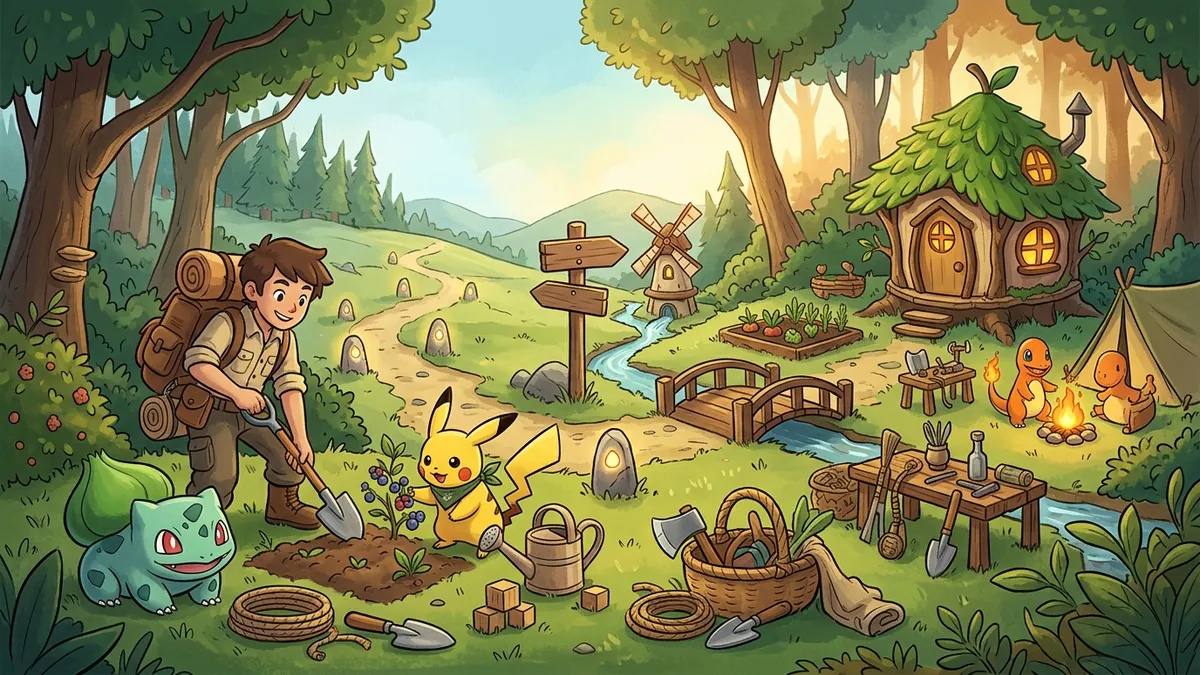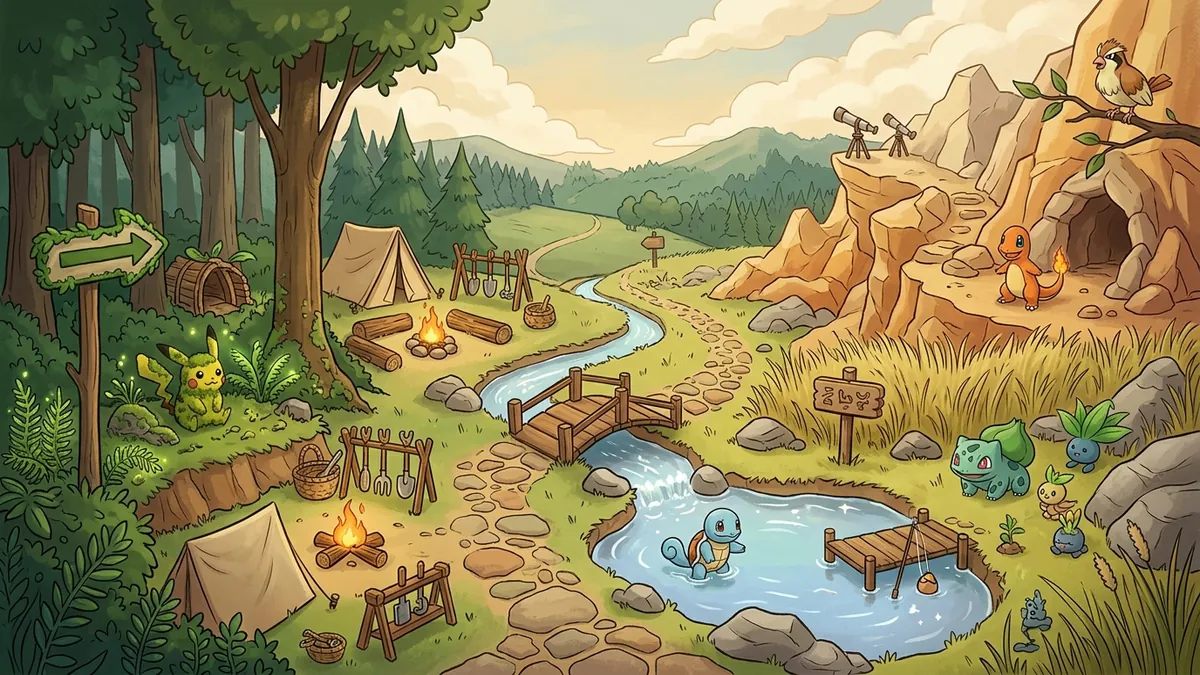
Mini-games in Pokemon Pokopia are not filler content. They are one of the primary ways to raise your Pokemon’s Comfort Level — a hidden stat that directly affects how well your befriended Pokemon perform their Specialties, how often they drop rare items, and how quickly they reach higher Friendship milestones. Playing jump rope with a Pikachu or running a quiz with an Abra is not just cute. It is a core gameplay loop with real mechanical rewards.
There are five mini-games in total, each with its own rules, scoring system, and strategy. Every Pokemon in Pokopia has preferences about which games it enjoys, and matching those preferences doubles your Comfort gains. This guide breaks down every mini-game, explains the Comfort system, and gives you the strategies to maximize your returns from each play session. If you are still early in the game and want a broader overview first, our beginner guide covers the foundations.
How the Comfort Level System Works
Comfort Level is a per-Pokemon stat that ranges from 0 to 100. Every befriended Pokemon starts at 10 Comfort when it first joins your roster. Comfort affects three things.
Specialty efficiency. A Pokemon at Comfort 50 performs its Specialty roughly 30% faster than the same Pokemon at Comfort 10. At Comfort 100, the efficiency bonus caps at 60%. This means a Bulbasaur with maxed Comfort grows crops nearly twice as fast as one you just befriended.
Rare item drops. Pokemon occasionally drop items when working on tasks. At low Comfort, these drops are common materials. As Comfort rises, the drop table shifts toward rarer items — seeds, dyes, crafting components, and even exclusive furniture blueprints at Comfort 80 and above.
Friendship multiplier. Comfort acts as a multiplier on all Friendship EXP your Pokemon earns. High Comfort means faster friendship progression, which unlocks new abilities and perks sooner.
Comfort decays slowly over time — about 2 points per in-game day if you do not interact with that Pokemon. This makes regular mini-game sessions important for maintaining your team at peak performance.
The three ways to gain Comfort are mini-games (the most efficient), feeding preferred foods, and placing the Pokemon near decorations it likes. Our environment level guide covers the decoration angle. This guide focuses on mini-games.
Mini-Game Basics and How to Start
To play a mini-game, walk up to any befriended Pokemon that is currently on your island (not stored in the PC) and press Y to open the Interaction menu. Select Play, and you will see a list of available mini-games with icons showing the Pokemon’s preference.
- Heart icon = Preferred game (2x Comfort bonus)
- Neutral face = Standard game (1x Comfort bonus)
- Dislike icon = Disliked game (0.5x Comfort bonus)
Preferences are determined by the Pokemon’s personality type. There are four personality types in Pokopia — Bold, Gentle, Curious, and Creative — and each type has a consistent set of preferred and disliked games. Our Ditto guide explains the personality system in more detail, since your own Ditto character also has personality traits that develop over the course of the game.
Each mini-game session lasts between 30 seconds and 3 minutes depending on the game type and your performance. You can play up to 3 Comfort-rewarding sessions per Pokemon per in-game day.
Jump Rope — Rules and Strategy
Jump Rope is the most accessible mini-game and available from the start. Your Pokemon holds one end of a rope (or spins it if the Pokemon is large enough), and you press A in rhythm to jump.
How it works:
- The rope swings at a steady pace. Press A just as the rope passes under your feet.
- Speed gradually increases every 10 successful jumps.
- Missing a jump ends the round.
- Your score equals total consecutive jumps.
Comfort rewards:
| Jumps | Comfort Points |
|---|---|
| 10-19 | 3 |
| 20-34 | 6 |
| 35-49 | 9 |
| 50+ | 12 + streak bonus |
The streak bonus adds 1 extra Comfort point for every 10 jumps beyond 50, capping at 5 bonus points (100 jumps). A perfect 100-jump run with a preferred Pokemon yields 34 Comfort points in a single session (17 base x 2 preference multiplier).
Strategy tips:
- Watch the rope shadow on the ground, not the rope itself. The shadow gives a clearer timing cue.
- Tap in rhythm rather than reacting. After the first few jumps, the timing becomes predictable — treat it like a metronome.
- Large Pokemon (Snorlax, Torterra) spin the rope slower at the start, giving you more time to settle into the rhythm.
- Small Pokemon (Pichu, Joltik) reach top speed faster but start at a moderate pace.
Personality preferences:
- Bold Pokemon love Jump Rope.
- Creative Pokemon dislike it.
Quiz — Rules and Strategy
Quiz is a trivia-style mini-game where your Pokemon asks you questions about the Pokopia world. The questions draw from your actual gameplay — what you have built, which Pokemon you have befriended, which recipes you have discovered.
How it works:
- The Pokemon presents a multiple-choice question with 4 options.
- You have 15 seconds to select the correct answer.
- Each round has 5 questions.
- Scoring is based on correct answers and speed.
Comfort rewards:
| Correct Answers | Comfort Points |
|---|---|
| 1-2 | 4 |
| 3 | 8 |
| 4 | 12 |
| 5 (perfect) | 15 |
Speed bonuses apply when you answer within 5 seconds: +1 Comfort per fast answer. A perfect round with all fast answers on a preferred Pokemon gives 40 Comfort points (20 base x 2 preference multiplier).
Common question categories:
- Pokemon knowledge: “Which Pokemon has the Grow Specialty?” or “How many Pokemon live on your island?”
- Building facts: “How many rooms have you built?” or “What material is your tallest structure made of?”
- Recipe recall: “What ingredients make a Berry Pie?” or “Which cooking station do you need for Stew?”
- Region trivia: “Which region has the most cave systems?” or “What is the restoration level of Rocky Ridges?”
Strategy tips:
- Quiz difficulty scales with your progress. Early-game questions are simple, but late-game questions draw from obscure recipe ingredients and Pokemon habitat preferences.
- Keep a mental note of your building stats and recipe ingredients — the game loves asking about these.
- If you are unsure, eliminate obviously wrong answers first. The game always includes at least one joke answer that is clearly incorrect.
- Curious Pokemon love Quiz and give enthusiastic reactions that make the animation faster between questions.
Personality preferences:
- Curious Pokemon love Quiz.
- Bold Pokemon dislike it.
Hide and Seek — Rules and Strategy
Hide and Seek is the only mini-game that uses your island’s actual terrain and structures. Your Pokemon hides somewhere on your island, and you have a time limit to find it.
How it works:
- Select Hide and Seek from the Interaction menu. The screen briefly fades.
- Your Pokemon scatters and hides somewhere within a radius based on your island size.
- A timer starts — 60 seconds for small islands, 90 for medium, 120 for large.
- Find the Pokemon and press A to tag it.
- Multiple Pokemon can play at once (up to your full active party of 6).
Comfort rewards:
| Result | Comfort Points |
|---|---|
| Found within 25% of time | 14 |
| Found within 50% of time | 10 |
| Found within 75% of time | 6 |
| Found before time runs out | 3 |
| Not found | 0 |
When playing with multiple Pokemon, each one found grants its own Comfort reward independently. Finding all 6 within 25% of the time limit is extremely difficult but gives 14 Comfort to each Pokemon (28 with preference multiplier).
Where Pokemon hide:
Pokemon hide based on their type and size. Small Pokemon fit behind furniture, inside barrels, and under tables. Medium Pokemon tuck behind walls, trees, and larger structures. Large Pokemon cannot hide inside buildings and instead stand behind large terrain features or press against cliff walls.
Water-type Pokemon often hide near water features. Ghost-type Pokemon can phase partially into walls, making them harder to spot. Flying-type Pokemon sometimes perch on rooftops.
Strategy tips:
- Build your island with hiding spots in mind and you will learn where Pokemon tend to go. After a few rounds, the patterns become predictable.
- Listen for audio cues. Hiding Pokemon make soft sounds — a giggle, a shuffling noise — that get louder as you approach.
- The camera can rotate fully, so check behind you and above you. Pokemon on rooftops catch many players off guard.
- Faster movement helps. If you have Scorbunny with its Sprint Specialty, use it during Hide and Seek rounds.
Personality preferences:
- Gentle Pokemon love Hide and Seek.
- Curious Pokemon dislike it.
Dance Rhythm — Rules and Strategy
Dance Rhythm unlocks at story chapter 3. It plays like a standard rhythm game — notes scroll across the screen and you press the corresponding button as they reach the hit zone.
How it works:
- Select Dance Rhythm from the Play menu.
- A music track plays (each Pokemon type has a unique musical theme).
- Button prompts (A, B, X, Y, and directional arrows) scroll from right to left.
- Press the correct button when the prompt reaches the hit zone.
- Songs last 60-90 seconds.
Comfort rewards:
| Accuracy | Comfort Points |
|---|---|
| Below 50% | 2 |
| 50-69% | 5 |
| 70-84% | 9 |
| 85-94% | 12 |
| 95-100% | 15 |
Dance Rhythm has the highest skill ceiling of all mini-games. A 95%+ accuracy run on a preferred Pokemon gives 30 Comfort, making it competitive with Quiz for raw efficiency if you have strong rhythm game skills.
Strategy tips:
- The hit zone has a “Perfect” center and a “Good” outer ring. Perfects count for full points while Goods count for half.
- Focus on the hit zone, not the incoming notes. Peripheral vision handles the scrolling better than tracking individual prompts.
- Electric-type Pokemon have the fastest tracks. Grass-type and Water-type Pokemon have the slowest and most forgiving rhythms.
- Practice with slow Pokemon first to learn the interface before attempting faster tracks.
Personality preferences:
- Creative Pokemon love Dance Rhythm.
- Gentle Pokemon dislike it.
Ball Toss — Rules and Strategy
Ball Toss unlocks at story chapter 5. You and your Pokemon throw a ball back and forth, with increasing speed and trick throws.
How it works:
- Your Pokemon throws a ball toward you. Move the cursor to catch it and press A.
- Then you throw it back. Aim at the Pokemon and press A — timing affects accuracy.
- Speed increases every 5 successful volleys.
- Trick throws start appearing at volley 15: curveballs, lobs, and spin shots that require precise cursor placement.
- Missing a catch or throw ends the round.
Comfort rewards:
| Volleys | Comfort Points |
|---|---|
| 5-9 | 3 |
| 10-19 | 7 |
| 20-29 | 11 |
| 30+ | 14 + bonus |
The bonus is 1 point per 5 volleys beyond 30, capping at 4 bonus points. Maximum possible Comfort from one session is 18 (36 with preference).
Strategy tips:
- Trick throws telegraph their trajectory with a colored trail. Red trails curve left, blue trails curve right, yellow trails are lobs.
- Your own throw accuracy does not affect your score, but a bad throw makes the Pokemon’s return harder because the rebound angle changes.
- Aim your throws at the Pokemon’s center. Off-center throws trigger more trick returns.
- Electric-type Pokemon throw the fastest. Normal-type Pokemon are the most predictable and best for practice.
Personality preferences:
- Bold Pokemon love Ball Toss.
- Creative Pokemon are neutral toward it.
Comfort Level Optimization Strategy
Now that you understand all five mini-games, here is how to optimize your daily Comfort routine.
Step 1: Check preferences. Open each Pokemon’s profile and note its personality type. Build a quick reference of which game each team member prefers.
Step 2: Play preferred games first. Always spend your 3 daily Comfort sessions on the preferred game for each Pokemon. The 2x multiplier is too valuable to ignore.
Step 3: Prioritize high-Specialty Pokemon. Your workhorse Pokemon — the ones doing most of your farming, cutting, or generating — benefit the most from Comfort boosts. Give them mini-game time before leveling up benched Pokemon.
Step 4: Batch sessions. Play mini-games with your entire active party in sequence during the morning portion of the in-game day. This ensures you hit all 3 daily sessions before getting absorbed in building or exploring.
Step 5: Supplement with food. After mini-game sessions, feed your Pokemon their preferred foods for an extra Comfort bump. The cooking guide lists every recipe and which Pokemon prefer which dishes.
Maintenance schedule: Once a Pokemon reaches Comfort 100, you only need one mini-game session per day to offset the 2-point daily decay. Shift your extra sessions to Pokemon that are still climbing.
Best Pokemon for Each Mini-Game
Some Pokemon are naturally better mini-game partners due to their personality type giving them preferences for the highest-reward games.
| Mini-Game | Best Pokemon (Personality) | Comfort per Session (Preferred) |
|---|---|---|
| Jump Rope | Machop, Riolu, Tyrogue (Bold) | Up to 34 |
| Quiz | Abra, Ralts, Slowpoke (Curious) | Up to 40 |
| Hide and Seek | Eevee, Happiny, Togepi (Gentle) | Up to 28 |
| Dance Rhythm | Smeargle, Grafaiai, Mime Jr. (Creative) | Up to 30 |
| Ball Toss | Growlithe, Rockruff, Mankey (Bold) | Up to 36 |
For a broader look at which Pokemon are worth investing time into and which provide the strongest overall utility, our Pokemon tier list ranks every species by usefulness.
FAQ
How do I start a mini-game in Pokemon Pokopia? Walk up to any befriended Pokemon and press the Y button to open the Interaction menu. Select Play to see which mini-games that Pokemon enjoys. Choose one and the game starts immediately.
What is Comfort Level in Pokemon Pokopia? Comfort Level is a hidden stat for each befriended Pokemon that tracks how happy and comfortable it feels. Higher Comfort Level improves Specialty efficiency, unlocks bonus perks, and increases the chance of rare item drops from that Pokemon.
Which mini-game gives the most Comfort in Pokopia? Quiz gives the highest single-game Comfort boost at 15 points per perfect round. However, Jump Rope is the most efficient over time because rounds are faster, and a 50-jump streak gives 12 points plus a streak bonus.
Do all Pokemon like the same mini-games in Pokopia? No. Each Pokemon has preferred and disliked mini-games based on its personality type. Playing a preferred mini-game gives double Comfort points, while a disliked game gives only half.
How many mini-games are there in Pokemon Pokopia? There are 5 mini-games: Jump Rope, Quiz, Hide and Seek, Dance Rhythm, and Ball Toss. Jump Rope, Quiz, and Hide and Seek are available from the start. Dance Rhythm unlocks at story chapter 3, and Ball Toss unlocks at chapter 5.
Can I play mini-games with multiple Pokemon at once? Yes. Jump Rope supports up to 3 Pokemon spinning or jumping together. Hide and Seek can involve your entire active party of 6. Quiz and Dance Rhythm are always one-on-one.
What rewards do mini-games give in Pokopia? Besides Comfort Level boosts, mini-games reward Life Coins, Friendship EXP, and occasionally rare drops like Berry Seeds, crafting materials, or cosmetic items tied to the Pokemon’s type.
Is there a daily limit on mini-games in Pokopia? There is no hard limit, but each Pokemon can only gain Comfort from mini-games 3 times per in-game day. After 3 sessions, the Pokemon will still play but will not receive Comfort boosts until the next day.
Mini-games are the easiest part of Pokopia to dismiss and one of the most impactful to master. A team running at Comfort 100 across the board outperforms a low-Comfort team by such a wide margin that daily mini-game sessions become non-negotiable once you see the difference. Build the habit early, match preferences, and your Pokemon will thank you with faster farms, rarer drops, and smoother progression.
For more on building the strongest possible team, check our best team composition guide. And for a full overview of everything Pokopia has to offer, visit our guides hub.