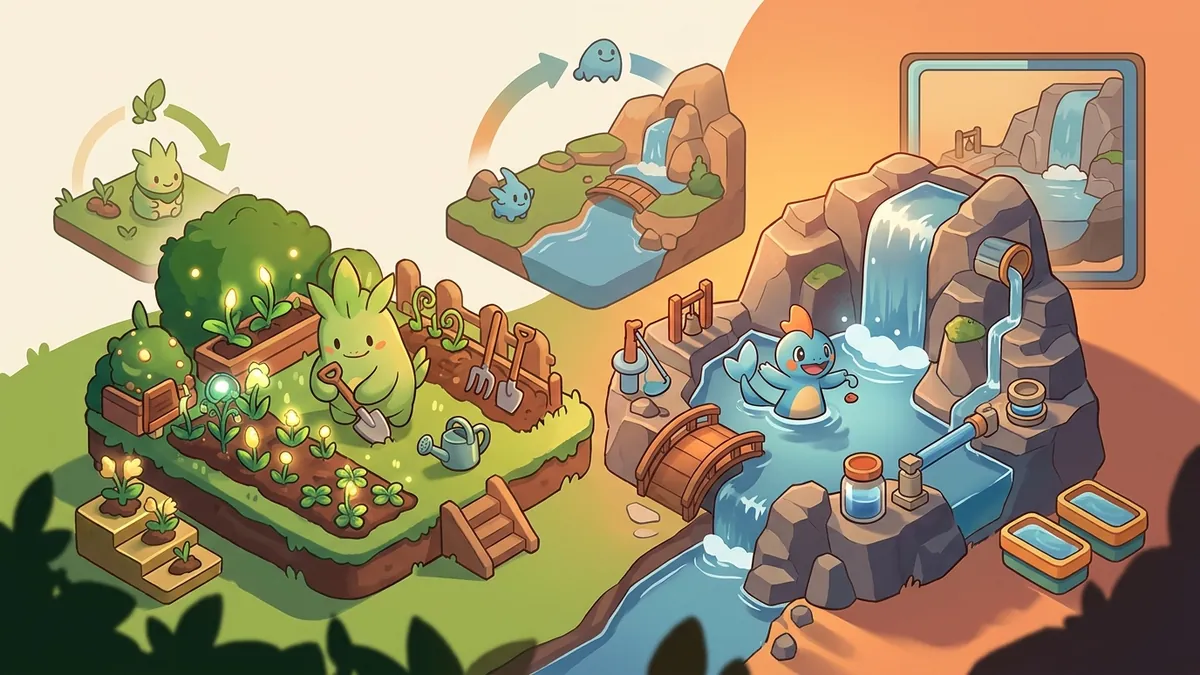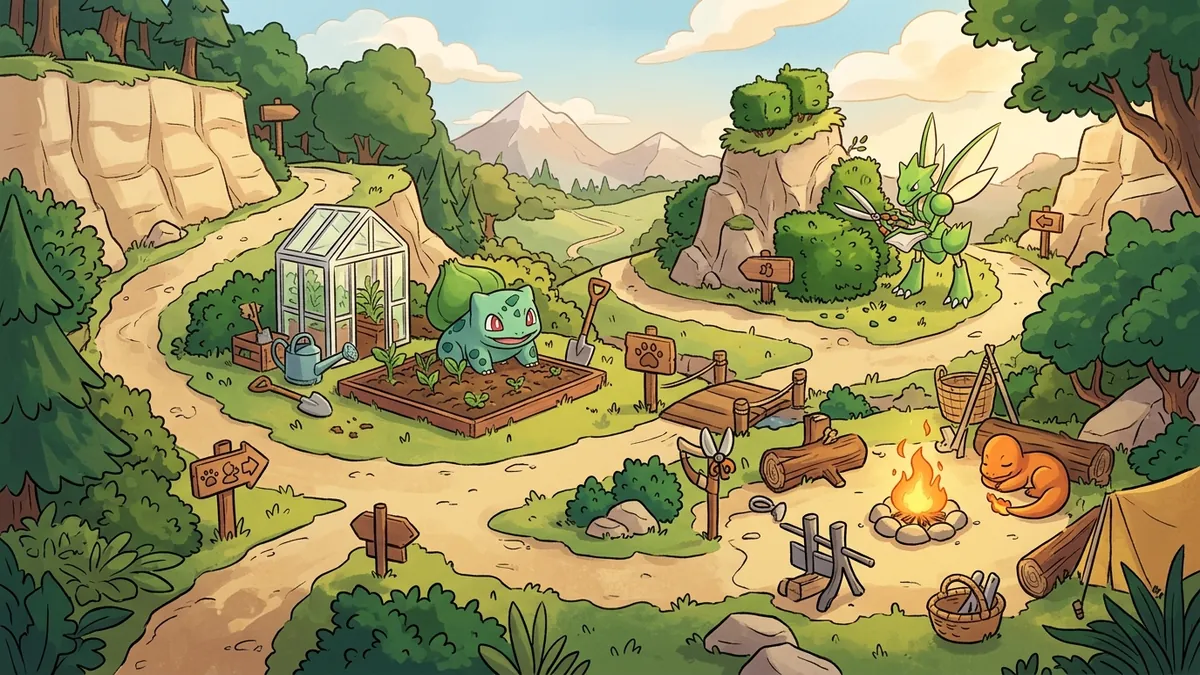
Pokemon Pokopia is packed with 311 catchable Pokemon across four regions, but seven of them are nothing like what you have seen in any other game. These are not regional forms or slight palette swaps. They are fully redesigned, lore-rich NPC variants that each play a critical role in how your island runs. You cannot catch them, you cannot trade for them, and you absolutely cannot ignore them.
From a ghostly Pikachu that powers your entire town to a paint-splattered Smeargle that redefines creativity, Pokopia’s seven unique Pokemon forms are some of the most memorable additions the franchise has ever put into a spinoff. This guide breaks down every single one of them — their backstories, their gameplay impact, and how to get the most out of each variant. If you are still learning the ropes, our Pokemon Pokopia Beginner Guide covers the fundamentals before you dive in here.
What Makes These Pokemon Forms Unique
The seven exclusive variants in Pokemon Pokopia are not normal Pokemon that happen to look different. They are story-critical NPCs that you meet throughout the campaign, each one tied to a specific gameplay system. Think of them as permanent residents on your island who offer services no regular Pokemon can replicate.
Here is what separates them from every other Pokemon in the game:
- They cannot be caught. Your Poke Balls will not work on them. They exist outside the normal catch-and-train loop.
- They have unique designs. These are not simple recolors. Each one has physical alterations, accessories, or entirely new visual elements that reflect their backstory.
- They serve specific roles. Each variant connects to one of Pokopia’s core systems — electricity, food, construction, education, music, art, or exploration.
- They have deep lore. Every variant has a backstory explaining how they became who they are. That lore is woven directly into the main storyline.
You will meet all seven as you progress through the main campaign. Some appear early, others show up in later regions. By the time you reach the endgame, every one of them is available on your island and actively contributing to your daily operations.
Peakychu — The Ghostly Electric Guardian
Peakychu is the first unique variant most players encounter, and it immediately sets the tone for how special these NPCs are. This is a female Pikachu, ghostly pale with a luminescent glow that pulses across her body. She looks like moonlight took physical form.
Her backstory is genuinely touching. Peakychu shared too much of her own electricity with friends and other Pokemon over the years, giving and giving until she could no longer generate any energy on her own. But instead of losing her connection to electricity entirely, she developed something new — the ability to manipulate external electrical sources. She cannot produce a single spark from her own body, but she can channel, redirect, and amplify electricity from anything around her.
In gameplay terms, Peakychu is your town’s power grid. She can light up an entire town on her own by drawing energy from the environment and distributing it to every lamp, building, and device on your island. If you have been frustrated by dark areas or unpowered structures, Peakychu is the permanent solution.
She works hand-in-hand with Mareep and its evolution line, which use the Generate specialty to path toward unpowered lamps and shock them into working. The difference is that Mareep handles individual fixtures while Peakychu manages the big picture. For a deeper look at how to build a power system, our building guide walks through electrical layouts step by step.
Mosslax — The Slumbering Spawn Booster
If Peakychu is elegant, Mosslax is pure comedy. This is a Snorlax that slept so long — we are talking geological timescales — that moss literally grew over its entire body. A small flower blooms on top of its head, swaying gently whenever Mosslax shifts in its perpetual half-sleep. Patches of green cover what was once smooth blue fur, giving Mosslax the look of a living hill.
Mosslax has the Eat Specialty, which is where things get interesting for your entire gameplay loop. When you feed Mosslax Spicy food, it triggers a spawn boost across all Pokemon habitats in your current region. That means more wild Pokemon showing up in every area, which translates directly into faster catches, faster specialty recruitment, and faster progress toward completing your Pokedex.
The spawn boost lasts for a set window after feeding, so smart players time their Mosslax meals right before major catching sessions. If you are hunting for a specific Pokemon in a particular habitat, feeding Mosslax first can cut your search time dramatically.
This connects directly to the farming pipeline. You need crops to cook Spicy recipes, which means your farming setup feeds directly into your catching efficiency. Mosslax turns the farming system from a nice side activity into a core progression tool.
Here are some tips for maximizing Mosslax:
- Stock up on Spicy ingredients before heading to a new region
- Time your feeds right before planned catching runs
- Combine with habitat knowledge — know where your target spawns, then boost the area
- Cook in bulk so you always have Spicy food ready to go
Smearguru — The Artistic Visionary
Smearguru takes everything you know about Smeargle and cranks it up to eleven. This variant is completely covered in dried paint splotches of every color — red, blue, green, purple, gold — splattered across its body in patterns that almost look intentional. Its tail brush is noticeably larger than a standard Smeargle’s, thick with accumulated paint from years of creative work.
While the standard Smeargle in Pokopia focuses on the basic painting mechanic, Smearguru operates on a higher level. This NPC oversees the artistic and creative systems on your island. It is your go-to for customization options, decorative projects, and any feature tied to visual expression.
Smearguru also connects to Grafaiai’s paint balloon mechanic, which is essential for Cloud Island exploration in multiplayer. Grafaiai shoots paint balloons to mark paths and create waypoints on Cloud Islands, and Smearguru provides the advanced paint supplies and techniques that make that system more effective. If you are playing with friends and tackling the multiplayer Cloud Islands, understanding the Smearguru-to-Grafaiai pipeline will save you hours of aimless wandering.
The creative tools Smearguru unlocks are also tied to your island’s visual identity. Custom patterns, building paint jobs, furniture coloring — all of it flows through Smearguru’s workshop. Visiting this NPC regularly and completing its side quests opens up increasingly wild customization options as you progress.
DJ Rotom — The Musical Maestro
Every good island needs a soundtrack, and DJ Rotom delivers. This Rotom variant has possessed a full DJ setup — turntables, speakers, equalizer, the works. It bobs and weaves through its equipment, crackling with electric energy while spinning tracks that affect the mood of your entire island.
DJ Rotom is more than just aesthetic flavor. The music system in Pokopia has real gameplay implications. Different tracks influence Pokemon behavior, NPC interactions, and even the pace of certain activities. DJ Rotom lets you set the vibe, and the vibe has consequences.
The stereo equipment DJ Rotom inhabits is significantly larger than the typical appliances Rotom possesses in other Pokemon games. This is not a Rotom stuck in a microwave. This is a Rotom that found its true calling — a wall of speakers, a mixer board, and a light rig that pulses in sync with every beat.
Where DJ Rotom becomes genuinely useful is during events and island gatherings. When you host visitors or participate in seasonal events, DJ Rotom’s music selections can boost the event’s rewards. The right playlist at the right time makes a measurable difference.
Players who take the time to unlock DJ Rotom’s full track library report noticeably smoother gameplay sessions. The music is not just background noise — it is a system, and DJ Rotom is the interface for that system.
Tinkmaster — The Engineering Powerhouse
Tinkmaster is officially called Supervisor Tinkaton, and it might be the most impactful unique variant in the entire game. This Tinkaton variant built a city of skyscrapers from scratch. Not a small town. Not a few buildings. An entire city skyline, constructed with its own two hands and its signature modified hammer.
That hammer deserves its own paragraph. Unlike a standard Tinkaton’s weapon, Tinkmaster’s hammer is a swiss army knife of tools — retractable saw blade, built-in level, extendable measuring tape, wrench head, and what appears to be a miniature crane attachment. This thing is an entire construction crew compressed into one tool.
Tinkmaster has the Engineering Specialty, and it is an absolute game-changer for anyone investing in the building system. When assigned as a project leader, Tinkmaster speeds up construction timers on every building project on your island. That includes houses, shops, infrastructure, decorations — anything that requires a build timer.
If you have been frustrated by waiting for buildings to finish, Tinkmaster is your answer. The speed boost is substantial enough that late-game construction projects that would normally take hours get cut down significantly. Our building guide covers how to prioritize build orders to stack Tinkmaster’s bonus most effectively.
Tinkmaster also plays a central role in the storyline missions related to island development. Several main quest objectives require specific buildings to be completed, and having Tinkmaster active during those missions makes progression noticeably faster.
Professor Tangrowth — The Scholarly Guide
Professor Tangrowth is Pokopia’s answer to the classic Pokemon professor, and the design choices tell a story all by themselves. Unlike a standard Tangrowth with red-tipped vines, Professor Tangrowth has entirely white vines — a visual signal of age, wisdom, and years spent in academic pursuit rather than wild exploration.
Perched on its vines near the neck area sit a pair of Wise Glasses, the held item from the mainline games repurposed here as a character design element. And stuck to one of its many vines is a TM disc, a nod to the teaching role this variant has embraced.
Professor Tangrowth serves as the Pokemon professor of the Pokopia world. It introduces you to core mechanics, explains the specialty system, hands out your starter Pokemon, and provides guidance at key story moments. If you have played any mainline Pokemon game, you know the professor archetype. Professor Tangrowth fills that role with a warmth and personality that makes the early hours of Pokopia feel genuinely welcoming.
Beyond the story role, Professor Tangrowth remains available on your island as an encyclopedia and advisor. You can visit anytime to get information about Pokemon species, specialty details, evolution methods, and habitat data. It is a living Pokedex that also gives hints about undiscovered Pokemon in each region.
For players building optimized teams, Professor Tangrowth’s advice on team composition is worth checking regularly. The hints it drops about specialty synergies can point you toward combinations you might not have considered.
The Complete Pokemon Specialty System
The seven unique variants are impressive on their own, but they exist within a larger framework — the Pokemon Specialty system. Every catchable Pokemon in Pokopia either has one or more specialties, or it has none. Specialties determine what tasks a Pokemon can perform on your island, and building the right specialty roster is the core strategic layer of the game.
Here is the full list of specialties and what they do:
| Specialty | Function | Notable Pokemon |
|---|---|---|
| Burn | Clears brush, smelts ore, cooks raw food | Charmander line, Vulpix, Litwick |
| Gather | Collects berries, flowers, surface materials | Butterfree, Aipom, Pachirisu |
| Grow | Accelerates plant and crop growth | Bulbasaur line, Oddish, Sunkern |
| Water | Irrigates crops, fills ponds, cleans | Squirtle line, Psyduck, Lotad |
| Generate | Powers lamps, machines, electrical devices | Mareep line, Pichu, Magnemite |
| Cut | Chops trees, clears wood, harvests lumber | Scyther, Farfetch’d, Kartana |
| Storage | Expands inventory and container capacity | Gulpin, Swalot |
| Engineering | Speeds up construction and repairs | Tinkmaster (NPC), plus select Pokemon |
| Eat | Consumes food for area-wide boosts | Mosslax (NPC), plus select Pokemon |
Some of these specialties are common across dozens of species. Others are extremely rare. The balance between specialty rarity and usefulness is what makes team building in Pokopia so engaging.
Best Pokemon by Specialty — Top Picks
Not all Pokemon with the same specialty perform equally. While the specialty itself does not improve with evolution, certain species complete their specialty actions faster or more efficiently. Here are the standout picks for each category, combining the unique NPC variants with the best catchable Pokemon.
Electricity and Power: Peakychu handles town-wide power, but Mareep is your bread-and-butter Generate Pokemon. Mareep automatically paths to unpowered lamps and shocks them into working. Stack several Mareep across your island and you will never deal with a dark corner again.
Food and Spawns: Mosslax is irreplaceable for spawn boosting through Spicy food. On the farming side, Bulbasaur’s Grow specialty and Squirtle’s Water specialty form the foundation of any serious crop operation.
Lumber and Clearing: Scyther dominates the wood economy with the Cut specialty. Its frame data is significantly faster than alternatives like Farfetch’d — roughly 36 percent faster on every chop. If you need lumber in volume, Scyther is the only real answer.
Storage: Gulpin and Swalot are the only Pokemon in the game with the Storage specialty. There is no alternative. If you want expanded inventory and container space, you need them. Swalot does not perform the specialty any faster than Gulpin, so catch whichever you find first.
Weather Control: Castform deserves special mention. While not a unique variant, Castform can force specific weather states for four-hour windows. Weather affects spawns, crop growth rates, and exploration conditions. A well-timed weather change from Castform can supercharge your entire session.
Construction: Tinkmaster is the Engineering powerhouse, but having additional Pokemon with construction-related abilities assigned alongside it stacks the speed bonus even further.
Exploration: Grafaiai’s paint balloon mechanic is essential for Cloud Island exploration. Shooting paint to mark paths and create waypoints makes multiplayer navigation dramatically easier. Pair Grafaiai’s fieldwork with Smearguru’s advanced supplies for the best results.
For a full ranking of every Pokemon by usefulness, check our Pokemon Pokopia Tier List, which breaks down S through D tier across all specialties.
How the Unique Variants Fit Into Your Island
The seven unique NPC variants are not just story characters you meet and forget. They stay on your island permanently and actively contribute to your daily routine. Here is how to think about integrating them:
Early Game (Regions 1-2): You will meet Peakychu, Professor Tangrowth, and Mosslax during the first two regions. Focus on getting your power grid running with Peakychu and start farming Spicy ingredients for Mosslax’s spawn boosts. Professor Tangrowth will guide you through starter mechanics.
Mid Game (Region 3): Smearguru and DJ Rotom become available. This is when customization and island aesthetics open up. Start experimenting with paint systems and music settings.
Late Game (Region 4): Tinkmaster arrives just when construction demands ramp up. The Engineering Specialty becomes critical for endgame building projects. Use Tinkmaster to push through construction bottlenecks.
Endgame: All seven variants working together create a self-sustaining island loop. Peakychu powers everything. Mosslax boosts spawns. Tinkmaster accelerates building. Professor Tangrowth provides intel. Smearguru handles aesthetics. DJ Rotom sets the mood. And the unnamed seventh variant ties remaining systems together.
The key is treating these NPCs as core infrastructure rather than optional extras. Players who engage with all seven variants from the moment they become available progress noticeably faster than those who ignore them.
Tips for Getting the Most Out of Each Variant
Here are practical strategies to maximize every unique Pokemon form on your island:
Visit Peakychu whenever you expand your island. New areas start unpowered. Peakychu needs to extend the grid, and the sooner you do it, the sooner your new Mareep start lighting lamps.
Keep a Spicy food stockpile for Mosslax. Never go into a catching session without feeding Mosslax first. The spawn boost is too good to waste.
Complete Smearguru’s side quests. Each quest unlocks new customization tiers. The rewards scale up dramatically in the late game.
Experiment with DJ Rotom’s playlists. Different music tracks have different effects. Track down the full library by exploring all four regions.
Assign Tinkmaster to your most expensive buildings. The speed bonus matters most on projects with long timers. Do not waste it on quick builds.
Check Professor Tangrowth’s hints regularly. The advice updates as you discover new areas. It often points toward rare Pokemon you might have missed.
Combine Grafaiai with Smearguru. The paint balloon mechanic for Cloud Island exploration gets significantly better when Smearguru upgrades your paint supplies.
For a full walkthrough of how to find every Pokemon across all four regions, our all Pokemon locations guide has the complete map.
FAQ
How many unique Pokemon forms are in Pokopia? There are 7 unique Pokemon variants exclusive to Pokemon Pokopia, each serving as a helpful NPC.
What is Peakychu in Pokemon Pokopia? Peakychu is a ghostly, pale Pikachu variant that can manipulate external electricity and light up entire towns.
What does Mosslax do in Pokopia? Mosslax is a moss-covered Snorlax with an Eat Specialty. Feeding it Spicy food boosts Pokemon spawns in habitats.
What is Tinkmaster’s specialty? Tinkmaster (Supervisor Tinkaton) has the Engineering Specialty, which speeds up building projects when assigned as leader.
Who is Professor Tangrowth? Professor Tangrowth is a Tangrowth variant with white vines and Wise Glasses who serves as the Pokemon professor in Pokopia.
What are Pokemon Specialties in Pokopia? Specialties are skills Pokemon use to help with tasks like Burn, Gather, Grow, Water, Generate, Cut, Storage, and Engineering.
Which Pokemon has the Storage Specialty? Gulpin and Swalot are the only Pokemon with the Storage Specialty.
Can I catch the unique Pokemon variants? The 7 unique variants are NPCs that help you throughout the story. They cannot be caught like regular Pokemon.