Short answer: choose Pokémon Pokopia if you want each session to feel like a visible building project powered by Pokémon abilities. Choose Animal Crossing: New Horizons if you want a gentle calendar-shaped routine, animal neighbors, collecting, and support for the original Nintendo Switch. Choose both if those two rhythms solve different moods for you.
This is a factual comparison, not a scorecard. It was rechecked against official Pokémon and Nintendo pages on 2026-08-26. We removed unsupported recipe totals, playtime estimates, event cadence claims, and absolute “winner” language from the previous version.
The current differences at a glance
| Question | Pokémon Pokopia | Animal Crossing: New Horizons |
|---|---|---|
| Hardware | Nintendo Switch 2 only | Original Switch; Nintendo Switch 2 Edition also available |
| Core pull | Build, craft, grow, restore, and work with Pokémon | Check in, meet neighbors, collect, decorate, and follow the calendar |
| Shared play | 1–4 local or online; persistent Cloud Island | Switch 2 Edition supports 1–12 online when everyone uses that edition |
| Smaller local sharing | GameShare supports up to two players | Party Play supports residents of the same island on one system |
| Special online space | Cloud Island | Slumber Island in the free Version 3.0 update |
| Hardware extras | Built around Nintendo Switch 2 | Switch 2 Edition adds Joy-Con 2 mouse controls, Megaphone, CameraPlay, and GameChat features |
| Current official update checked | Pokémon’s 2026 launch and multiplayer pages | 3.0.3, released 2026-04-29 |
The table describes different designs, not quality. Try the five-choice field test before reading the details:
A five-choice field test
Which island life fits you?
Choose the rhythm that sounds better today. This matcher weighs preferences, not review scores or invented statistics.
What should pull you into the next session?
What kind of creativity feels better?
Pick the online setup you actually expect to use.
Which hardware boundary matters?
Who should make the world feel alive?
Your field note is ready
Your stronger match: Pokémon Pokopia
You leaned toward project-led building, Pokémon teamwork, and smaller persistent Cloud Island sessions. Pokopia is the better first read for that profile.
Your field note is ready
Your stronger match: Animal Crossing
You leaned toward calendar-shaped island life, animal neighbors, collection-led decorating, or original Switch support. Animal Crossing is the better first read for that profile.
Your field note is ready
Your result: both scratch different itches
Your choices split between active world-building and a slower social routine. There is no universal winner here; the comparison below shows where each one differs.
The decision is really project versus routine
Pokopia presents island life as an active restoration project. Ditto learns moves from other Pokémon, gathers materials, grows crops, crafts objects, and creates places where Pokémon can live. The satisfying question is usually, “What can I change or finish next?” Pokémon are collaborators in that work, so collecting them is tied to what they help you do.
Animal Crossing treats island life more like a place you revisit. Its real-time calendar, changing shop stock, neighbors, museum collections, fishing, bug catching, clothing, furniture, and seasonal changes turn a short check-in into the core ritual. You can pursue large design projects, but the game does not need every session to advance a formal objective.
That is the most useful buying distinction. If you prefer a visible task and a world that changes through your actions, start with Pokopia. If the comfort comes from returning to familiar neighbors and noticing what changed today, start with Animal Crossing.
Building and decorating feel different
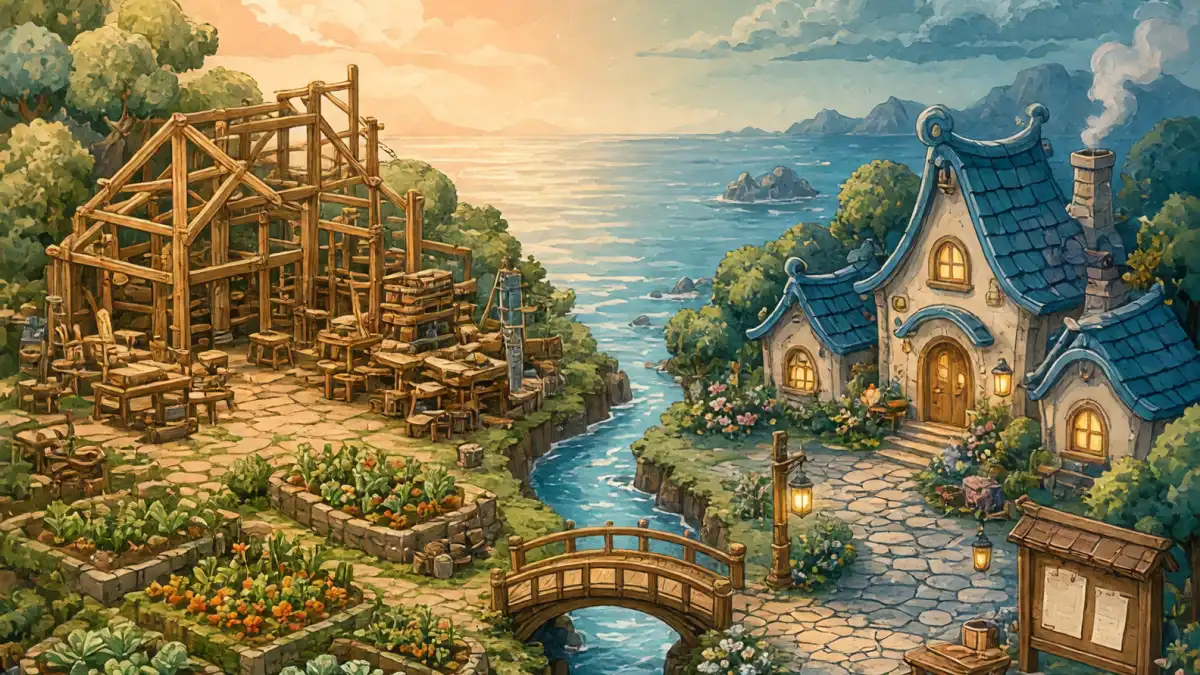
Pokopia puts making and restoring the environment near the center. Official descriptions show Ditto learning Pokémon moves to add greenery, water plants, gather resources, craft furniture, and build habitats. The fantasy is not simply owning a furnished home; it is turning an undeveloped place into a functioning Pokémon settlement.
Animal Crossing emphasizes curation. You collect furniture, clothing, art, creatures, DIY recipes, paths, plants, and landscaping tools, then arrange them into a coherent island. Version 3.0 also added hotel-related DIY requests and quality-of-life changes such as batch crafting up to ten items and using materials stored at home.
So ask what kind of blank canvas you enjoy:
- Pokopia better serves a maker mindset: gather, transform, construct, and restore with Pokémon.
- Animal Crossing better serves a curator mindset: collect, arrange, personalize, and revisit a lived-in community.
Neither description proves how many hours you will enjoy. Playtime depends on pace, completion goals, multiplayer use, and how often you redesign.
Hardware: the old comparison is no longer accurate
Pokémon Pokopia is a Nintendo Switch 2 game. It is not available for the original Nintendo Switch.
Animal Crossing: New Horizons still runs on the original Switch, but “backward compatibility only” is outdated. Nintendo released a dedicated Nintendo Switch 2 Edition on January 15, 2026. Owners of the original game can also use an upgrade path where available.
The Switch 2 Edition adds or expands features that matter in this comparison:
- Joy-Con 2 mouse controls for decorating rooms, creating Custom Designs, and writing on the bulletin board.
- The in-game Megaphone, which uses the system microphone to call a resident’s name.
- CameraPlay and GameChat integration for seeing friends during sessions.
- Online sessions for 1–12 players when every participant uses the Nintendo Switch 2 Edition.
The free Version 3.0 content is broader than the paid hardware edition: Nintendo made the update available to both original Switch and Switch 2 players. If original Switch support is non-negotiable, Animal Crossing is the only one of these two that qualifies.
Multiplayer: Cloud Island and Slumber Island are not equivalents
Pokopia supports 1–4 players in local or online play. Its distinctive shared feature is Cloud Island. Nintendo’s official guide says the owner uploads the world, chooses who may edit it, and can protect access with a Link Code. Permitted players can continue using that Cloud Island when the owner is not playing. That makes it suitable for a small group contributing on different schedules.
Pokopia also supports GameShare for up to two players. That is a smaller nearby-sharing option, not a replacement for the four-player Cloud Island model.
For setup steps, permissions, and the difference between each Pokopia visit type, use our complete Pokopia multiplayer guide.
Animal Crossing uses a different structure. Regular island visits are social sessions centered on a host island. With Nintendo Switch 2 Edition, online play can reach 1–12 participants when all players use that edition. That is a larger live gathering than Pokopia offers, but it is not a persistent, asynchronously editable world.
Slumber Island, introduced with the free Version 3.0 update, is another distinct concept. Eligible Nintendo Switch Online members can create and save dream islands, select layouts and sizes, adjust environments, and invite friends to build together. It is a creative dream space rather than the resident’s main island, so “Cloud Island versus Slumber Island” is not a simple feature-count contest.
Choose by the group behavior you expect:
- A small group contributing to the same persistent project at different times: Pokopia’s Cloud Island is the closer fit.
- A larger live Nintendo Switch 2 gathering: Animal Crossing’s 1–12 online mode is the closer fit.
- A low-friction two-person Pokopia session: check GameShare compatibility for the participating systems.
Pokémon collaborators versus animal neighbors
Pokopia’s inhabitants are recognizable Pokémon, but their role is connected to restoration and creation. Ditto learns from them, and their abilities help change the environment. The bond is shaped by shared work: the creature you discover can also unlock a new way to grow or build.
Animal Crossing’s residents are neighbors. They have homes, routines, conversations, preferences, birthdays, and community roles. They are not a workforce or an ability loadout. Much of the emotional appeal comes from familiarity over real-world time.
If “I want to do things with Pokémon” is the primary fantasy, Pokopia answers it directly. If “I want a tiny town whose residents know me” is the fantasy, Animal Crossing remains structurally closer.
Updates and long-term rhythm
Animal Crossing’s official support history lists Version 3.0.3, released 2026-04-29, as the latest version we verified. The major Version 3.0 update arrived earlier in January 2026 with the resort hotel, Slumber Island, Resetti’s cleanup service, collaborations, and crafting improvements.
Our Animal Crossing Version 3.0 and Switch 2 Edition guide separates the free update from the optional hardware upgrade. If neither island loop feels quite right, compare six different rhythms in the Cozy Games field guide.
Pokopia has its own updates and live features, but this comparison does not assume a fixed event schedule or use an unverified content count as evidence of longevity. The safe conclusion is narrower: both games can change after purchase, and exact live-event details should be checked against their current official notices.
For a game you intend to play for months, the question is not “Which has more content?” without a defined metric. Ask whether you prefer Pokopia’s project loop or Animal Crossing’s calendar loop. That preference is more durable than a launch-week checklist.
Which should you choose?
Start with Pokémon Pokopia if…
- Nintendo Switch 2-only support is acceptable.
- You want building, crafting, growing, and restoration to drive the session.
- Pokémon should participate in changing the world, not only inhabit it.
- Your likely multiplayer group is 1–4 people.
- A persistent Cloud Island that approved friends can use asynchronously fits your group.
Start with Animal Crossing: New Horizons if…
- You need original Nintendo Switch support.
- You want real-time seasons, collecting, decorating, and neighbor routines.
- The social fantasy matters more than a project-led progression loop.
- Your Nintendo Switch 2 group may need the larger 1–12 online mode.
- Joy-Con 2 decorating, Megaphone, CameraPlay, or Slumber Island specifically appeal to you.
Play both if…
You want an active creation game for longer project sessions and a quiet social ritual for shorter check-ins. Similar “cozy island” framing does not make their core rhythms redundant.
What this comparison does not claim
We do not assign a universal winner, predict your playtime, or publish exact crafting and creature totals without a current primary source. We also do not treat launch marketing as a review score. The facts above explain platform and feature differences; taste still decides which loop feels better.
Official sources checked
- Pokémon Day 2026 Pokémon Presents news — official description of Pokopia’s shared play.
- Nintendo: How to Play Multiplayer in Pokémon Pokopia — player limits, Cloud Island, Link Code, permissions, and GameShare.
- Animal Crossing: New Horizons Nintendo Switch 2 Edition — Joy-Con 2, Megaphone, CameraPlay, and expanded online play.
- Nintendo: Animal Crossing update history — Version 3.0.3 and release date 2026-04-29.
FAQ
Is Pokémon Pokopia better than Animal Crossing: New Horizons?
There is no universal winner. Pokopia is the stronger fit for project-led building with Pokémon collaborators and a persistent Cloud Island. Animal Crossing is the stronger fit for calendar-paced island life, animal neighbors, collecting, and original Switch support.
Can I play both games on the same console?
Yes on Nintendo Switch 2. Pokémon Pokopia requires Nintendo Switch 2. Animal Crossing: New Horizons also runs on the original Switch, while its Nintendo Switch 2 Edition adds hardware-specific features.
How many players do the games support online?
Pokopia supports 1–4 players in local or online play, including Cloud Island. Animal Crossing: New Horizons Nintendo Switch 2 Edition supports 1–12 online players when everyone uses that edition.
Are Cloud Island and Slumber Island the same kind of feature?
No. Pokopia’s Cloud Island is a persistent shared world that permitted players can use even when its owner is absent. Animal Crossing’s Slumber Island is a separate dream-building space introduced in the free Version 3.0 update.
What is the latest Animal Crossing: New Horizons version?
Nintendo’s official update history lists Version 3.0.3, released on 2026-04-29. This page was last checked on 2026-08-26.