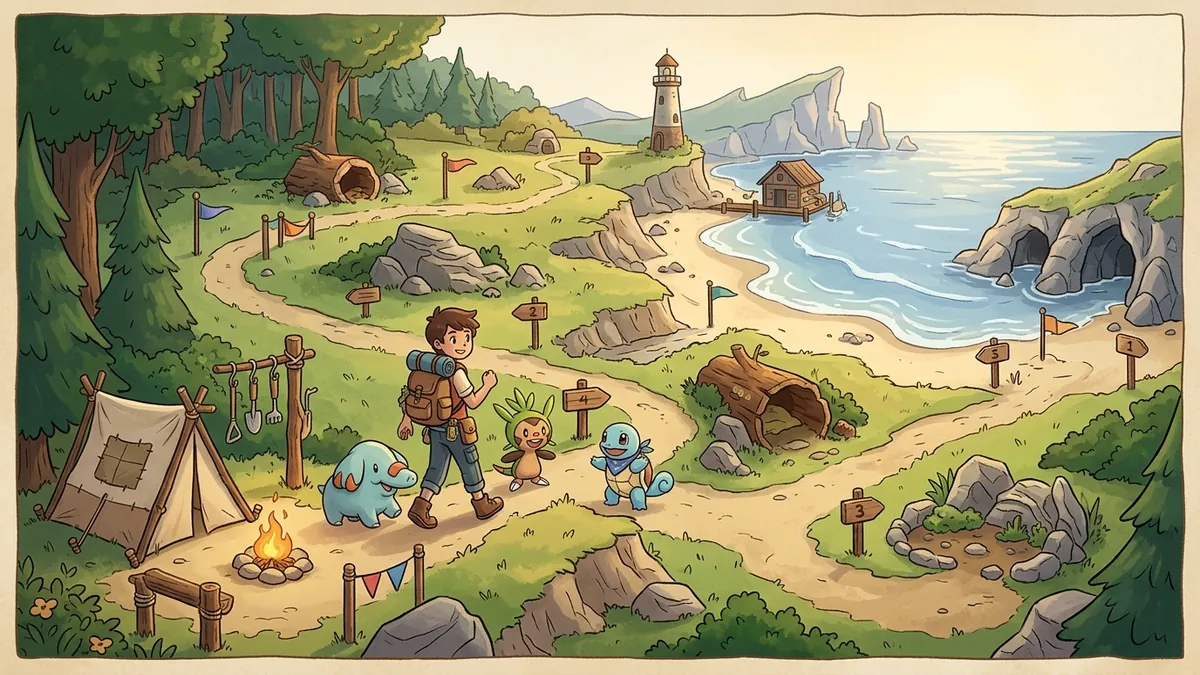
Withered Wastelands is Pokémon Pokopia’s starting story area. It covers the ruins of Fuchsia City with grassy ground, caves, and coast. The central restoration task is rebuilding habitats, bringing back rain, and making Pokémon comfortable — not racing through a secret dungeon or chasing fixed spawns.
What Opens After Withered Wasteland?
Finish the Important Request “Yawn up a storm!” to unlock both Bleak Beach (east route) and Rocky Ridges (west route) at the same time. You can visit either first and must eventually clear both. See the full area order and exploration guide for the complete story path.
Common misconception: There is no 40% restoration unlock for leaving Withered Wasteland. The story opens both routes after you complete Yawn up a storm!, regardless of Environment Level or completion percentage. You also do not need 100% area completion before leaving; follow your in-game Important Request screen if it disagrees with a web guide.
First-Session Checklist
- Befriend the Kanto starters — Squirtle, Bulbasaur, and Charmander during the scripted opening.
- Build early habitats — Hitmonchan (Rock Smash), Scyther (Cut), Timburr (Build specialty), then find Drilbur for Rototiller after breaking the east wall.
- Complete Yawn Up A Storm — Attract Slowpoke with its seaside habitat, raise humidity to 100 by following yellow requests, build Squirtle’s Rain Dance Site, trigger rain, meet Kyogre, and free Onix from the cave.
- Rebuild the Pokémon Center — Gather 20 Lumber, 20 Stone, 10 Leaf, and 10 Vine Rope, then assign Onix (Bulldoze), Timburr (Build), Scyther (Chop), and five others.
- Reach Environment Level 5 — Complete the main Important Requests and improve Pokémon Comfy Levels for the first-area milestone.
Related Guides
- All Pokopia areas, order, and unlocks
- Withered Wasteland Pokémon and habitat guide
- 300-entry Pokédex tracker
- Comfort Level and furniture guide
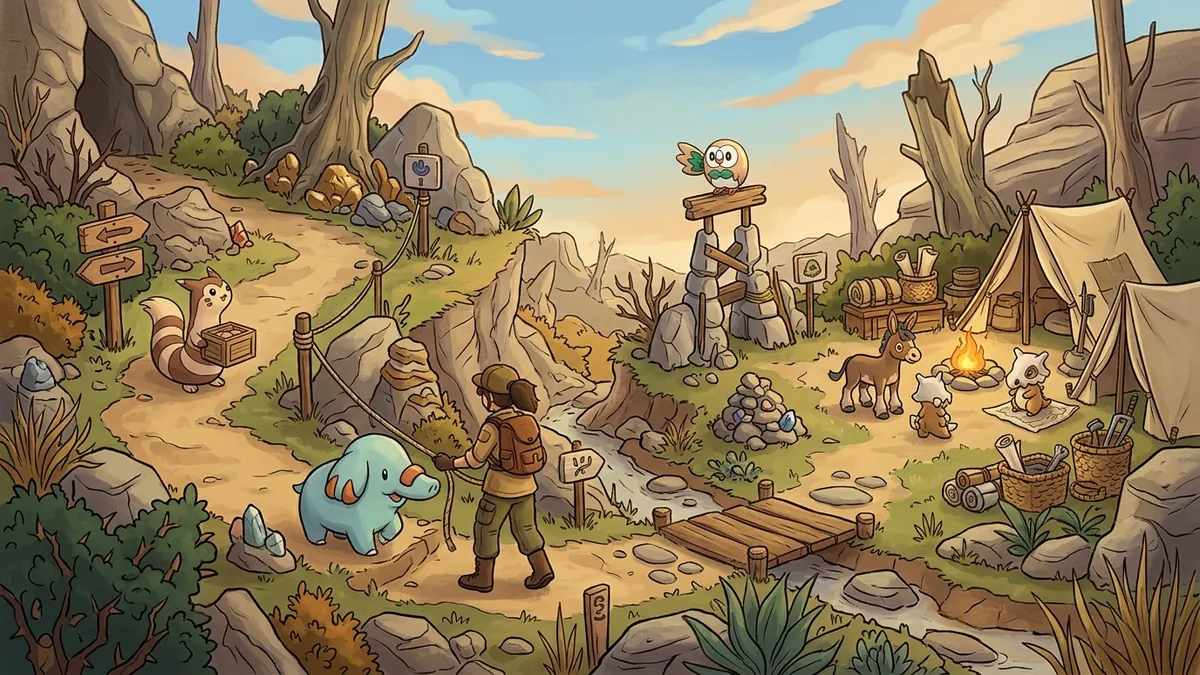
Withered Wastelands is Pokémon Pokopia’s first story area. It contains grassy ground, caves and a coast on the remains of Fuchsia City and its surroundings. Its central problem is not a secret dungeon or a fixed spawn route: the land has gone without rain, and the chapter teaches you to rebuild habitats, restore water and make Pokémon comfortable.
This walkthrough was fact-checked on 2026-08-25. It replaces older claims about five named sub-zones, hidden level-gated gardens, fixed wild spawns and invented rewards. Follow the Important Request screen whenever your save and a web guide disagree.
Fast route
- Befriend Squirtle, Bulbasaur and Charmander during the opening.
- Activate the ruined PC and complete the first three Challenges: find six Pokémon, water five trees and gather ten Sturdy Sticks.
- Build habitats for Hitmonchan, Scyther and Timburr.
- Learn Rock Smash from Hitmonchan and Cut from Scyther.
- Reach Environment Level 2, build and furnish your Leaf Hut, then claim it with the flag.
- Break the wall east of the Center and befriend Drilbur for Rototiller.
- Reach Environment Level 3 and buy the Pokémon Center Rebuilding Kit for 1,000 Life Coins.
- Explore the cave, find the trapped Onix and begin Yawn Up A Storm.
- Attract Slowpoke, guide it to Professor Tangrowth and raise humidity to 100.
- Trigger rain, meet Kyogre, return to the cave and free Onix.
- Gather the Center materials and assign eight Pokémon.
- Complete the main Important Requests and reach Environment Level 5 for the early area-completion milestone.
Opening: the three Kanto starters
Outside the starting cave, use Water Gun to revive Squirtle. The opening then teaches Leafage through Bulbasaur and brings Charmander to the first campsite. These are scripted introductions, not random map spawns.
On the following day, go to the ruined Pokémon Center with Professor Tangrowth and activate the terminal. The first Challenges shown by the PC are:
- Find new Pokémon: 6
- Water trees: 5
- Gather Sturdy Sticks: 10
Sparkling habitat hints point you toward useful early builds. Three are especially important:
| Pokémon | Habitat | Why it matters |
|---|---|---|
| Hitmonchan | Punching Bag connected to any Seat | Its request teaches Rock Smash after you bring two Stone |
| Scyther | Any Large Tree connected to four Tall Grass | Its request teaches Cut after you bring two Sturdy Sticks |
| Timburr | One Large Boulder connected to four Tall Grass | Its Build specialty is needed for construction |
Turn the Challenges in at the PC. Bulbasaur then asks for a Straw Bed, made with two Leaf. Improving habitats and satisfying requests raises Pokémon Comfy Levels, which feed the area’s Environment Level.
Environment Level 2: house, Cut, Rock Smash and Drilbur
At Environment Level 2, buy a Leaf Hut kit. The story asks you to build it with two Pokémon, including one with the Build specialty, wait for construction, place three pieces of furniture inside, and use the flag to claim it.
Do not skip the movement abilities:
- Cut comes from befriending Scyther and cuts grass and trees.
- Rock Smash comes from befriending Hitmonchan and breaks rocks.
- Rototiller comes from Drilbur and tills soil for seeds.
To find Drilbur, break through the wall east of the ruined Center after you have Rock Smash. This is an authored story route; Drilbur is not a timed spawn in a fan-made map zone.
Environment Level 3: buy the Center kit
At Environment Level 3, the Pokémon Center Rebuilding Kit appears in the local PC shop for 1,000 Life Coins. Buying it places the project over the ruins, but the Center cannot be completed until you find a Pokémon with Bulldoze.
Follow Squirtle through the breakable route toward the cave. Inside, you will hear Onix behind blocks that Ditto cannot yet remove. The rescue and the area’s rain problem converge into Yawn Up A Storm.
Yawn Up A Storm: Slowpoke and 100 humidity
Professor Tangrowth’s plan is to have Slowpoke yawn hard enough to start rain. Build Slowpoke’s habitat with four Tall Grass connected to ocean water. Speak to Magikarp nearby as well; befriending it teaches Splash, which lets Ditto jump with R.
Slowpoke dislikes the barren route. Craft stairs and wooden paths, then lay a traversable path back to Tangrowth. If Slowpoke stops, talk to it again.
The humidity phase is objective-driven. Open the Important Request and talk to every Pokémon with a yellow speech bubble. The documented world actions include:
- Break the cracked block on the northwest wall to release the spring and restart the north river.
- Remove blocks near the fountain so water reaches it.
- Use Water Gun on dry trees, grass and flower patches.
- Complete Bulbasaur’s and Squirtle’s linked requests.
- Build Squirtle’s Rain Dance Site with plated food and two Castform Weather Charms. Tangrowth has the charms in his wheelbarrow at his former home.
Keep going until the request meter reaches 100 humidity. There is no need to spam unrelated decorations: the request tracker tells you which restoration actions still count.
When the site is ready, feed Squirtle from the plated food, then speak to Slowpoke. Its yawn starts a brief shower and a cry comes from the southern coast. Meet Kyogre there; after the conversation, the rain persists. The cave blocks around Onix soften, allowing you to return and free it.
Rebuild the Pokémon Center
The current requirement shown by Nintendo Life, Game8 and other recent guides is:
| Material | Amount |
|---|---|
| Lumber | 20 Lumber |
| Stone | 20 Stone |
| Leaf | 10 Leaf |
| Vine Rope | 10 Vine Rope |
You also assign eight different Pokémon:
- Onix with Bulldoze
- Timburr with Build
- Scyther with Chop
- Five other Pokémon
Lumber is produced through a Chop-specialty Pokémon; Scyther can turn two Sturdy Sticks into Lumber. Stone is plentiful around the Wastelands. Leaf can come from plants or cutting Tall Grass. Vine Rope can come from cutting cave vines or a suitable Litter-specialty Pokémon.
Source discrepancy: Serebii’s compact Center table currently lists 10 Lumber and 10 Vines, while Nintendo Life, Game8 and the photographed build step report 20 Lumber and 10 Vine Rope. Bring the larger set and trust the requirement panel in your own save.
Construction completes at the next in-game day rollover. Once restored, the Center provides PP recovery, trade activity when a Trade-specialty Pokémon is present, and the 3D Printer.
When is Withered Wasteland complete?
Freeing Onix and reporting back to Tangrowth ends the local rain story. The east route leads toward Bleak Beach and the west route toward Rocky Ridges. You can choose either.
For progression purposes, Environment Level 5 plus the area’s main Important Requests is the first meaningful completion target. Environment Level is not a simple count of buildings: Pokémon need habitats, and higher Comfy Levels, requests and construction all contribute. The area can later reach Level 10, so Level 5 is not 100% completion.
If the bar stalls:
- Give every resident a valid habitat; a Pokémon without one has a Comfy Level of 0.
- Ask residents what they want, give gifts and speak to them daily.
- Use preferred habitat conditions such as warm, humid or dark.
- Complete requests and add useful building kits.
- Avoid removing happy residents, because that can lower the score and even reduce Environment Level.
For the Pokémon side of this chapter, use the Withered Wasteland Pokémon and habitat guide. For the full roster, the 300-entry Pokédex tracker is the safer reference.
FAQ
How do I finish Yawn Up A Storm?
Attract Slowpoke, build its path, complete the humidity objectives, set up Squirtle’s Rain Dance Site, meet Kyogre and return to free Onix.
How do I reach 100 humidity?
Follow the yellow requests, release the blocked spring, reconnect the fountain and restore dry vegetation with Water Gun.
What does the Center require?
Prepare 20 Lumber, 20 Stone, 10 Leaf and 10 Vine Rope, then assign Onix, Timburr, Scyther and five other Pokémon. Trust your in-game build panel if a web table differs.
Sources and review notes
- Serebii — Withered Wastelands location
- Serebii — Important Requests
- Serebii — habitat mechanics
- Serebii — Environment and Comfy Levels
- Serebii — Pokémon Centers
- Serebii — Ditto abilities
- Nintendo Life — Yawn Up A Storm walkthrough
- Nintendo Life — rebuild the Withered Wasteland Pokémon Center
PokopiaCenter is an independent fan guide. We name source conflicts instead of silently blending them; your in-game request and construction screens remain the final authority.